HOA ADA Compliance Sidewalk Requirements: Board Guide
Updated: Sep 14
HOA ADA Compliance Sidewalk Requirements for Community Boards
HOA ADA compliance sidewalk requirements give community boards a practical framework for reviewing accessible routes. They also guide trip-hazard response and maintenance records. Exact legal duties depend on property use, ownership, governing documents, and applicable state and local rules. This guide is an operational starting point, not legal advice.
For an HOA, the goal is not to treat every concrete defect as the same problem. The board should identify routes connecting homes, parking, entrances, mail areas, and amenities. It should measure conditions consistently and create a record showing how hazards were prioritized and corrected. That process supports resident safety, reserve planning, board approval, and a more informed conversation with an accessibility or legal professional.
This article focuses on the intersection of ADA planning and HOA operations. For the broader maintenance framework, see our guide to HOA sidewalk maintenance and repair. That guide serves as the related HOA sidewalk safety and compliance planning resource for this cluster.
How HOA ADA Compliance Sidewalk Requirements Apply to Private Communities
Short answer: Private HOA ownership does not automatically eliminate accessibility duties or the risks of an unsafe shared route. The applicable standard depends on how the property and facilities are used, who controls them, and which federal, state, local, fair housing, contractual, and insurance requirements apply.
Many HOAs manage sidewalks, pathways, ramps, parking connections, and routes to shared amenities. Those areas may serve residents, guests, vendors, employees, or members of the public. A clubhouse rented for public events raises different questions from a private path used only by residents. A board should not assume that one ownership label answers every compliance question.
When Title III may matter
Title III of the Americans with Disabilities Act addresses places of public accommodation. A private residential association is not automatically a place of public accommodation simply because it owns common areas. However, a particular facility or operation may have public-facing characteristics that require a closer analysis.
A clubhouse, community center, or amenity that offers access beyond the resident population can change the facts. When a facility is covered, the route to an accessible entrance or amenity deserves attention. The 2010 ADA Standards for Accessible Design provide a federal reference for accessible routes, surfaces, ramps, and related elements. They do not replace a site-specific review of the association's responsibilities.
Why Title II is a different question
Title II applies to state and local government entities. A private HOA does not become a government entity because its sidewalks are near a public street or connect to a municipal route. Publicly owned sidewalks and private common areas may have different responsible parties, standards, and repair processes.
Map the property boundary when a defect crosses or approaches a public right of way. Governing documents can assign maintenance duties, while state or local codes may establish accessibility or property standards. Fair housing requirements may affect reasonable accommodation requests. A board should obtain qualified legal or accessibility guidance when a complaint, demand, property-use question, or jurisdiction-specific rule is involved.
The practical board standard
Even when the legal analysis is uncertain, a board can take responsible operational action. Inspect common-area routes, record objective conditions, respond to reported hazards, communicate the repair plan, and keep evidence of completion. A consistent process helps the board make decisions based on route importance and observed risk instead of waiting for an injury or an escalating complaint.
What Standards Apply to HOA Sidewalks, Ramps, and Pathways?
Short answer: Start with accessible-route concepts in the 2010 ADA Standards and guidance from the U.S. Access Board, then confirm which provisions apply to the specific property. Review clear width, slope, surface condition, level changes, curb ramps, and route continuity together because a path can fail in more than one way.
The U.S. Access Board guidance for ramps and curb ramps is useful when a route includes grades, landings, or transitions. The measurements below are common planning reference points for board discussions. They are not a substitute for a professional accessibility assessment, code review, or legal opinion.
Condition. | What the board should review. | Common reference point. |
Clear width. | Usable space between permanent obstructions. | 36 inches minimum for a single wheelchair to pass. |
Cross slope. | Side-to-side slope across the walking surface. | No more than 2 percent, or 1:48, on an accessible route. |
Running slope. | Lengthwise grade and whether the segment functions as a ramp. | Ramp conditions commonly use a maximum slope of 1:12. |
Surface. | Cracks, spalling, loose material, standing water, and abrupt changes. | Firm, stable, and slip-resistant walking surface. |
Level changes. | Raised joints, settled panels, and transitions at route connections. | Measure each change and evaluate the entire route. |
Measure the route, not only the defect
A raised joint may be the most visible problem, but the board should review the entire connected route. Check whether tree roots, landscaping, parked vehicles, gates, drainage, construction, or furniture reduce usable access. A repair that removes one visible hazard may not solve a route problem if the next segment remains blocked or difficult to navigate.
Record measurements in a consistent format. Note the route name, location, direction of travel, nearby landmark, date, weather conditions, and photographs. If the board uses a location ID or map, use the same identifier in the inspection record, work authorization, completion report, and follow-up review.
How to Conduct an ADA Compliance Audit of Community Sidewalks
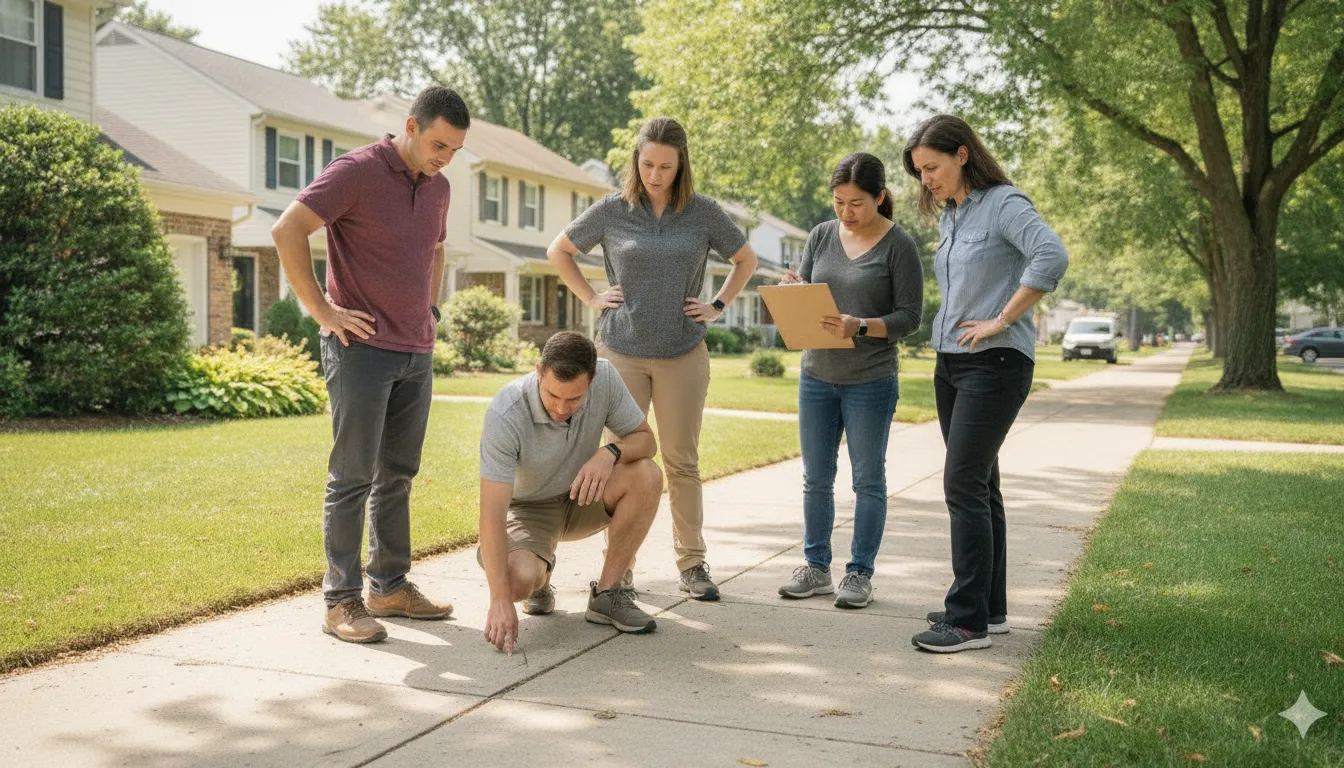
Short answer: An HOA sidewalk audit should map important routes and measure access conditions. Photograph each finding, assign a priority, and preserve the board's decision and completion record. A repeatable audit makes maintenance easier to manage. It also gives future board members a clear history of what was found and why each repair was selected.
1. Define the inspection area
Begin with a map of common-area walkways and the destinations they connect. Include entrances, parking, mail facilities, recreational areas, trash enclosures, pools, clubhouses, and connections to public sidewalks. Note paths that receive heavy use or provide the practical route to an essential community destination.
2. Inspect accessible-route conditions
Walk each route in both directions when practical. Look for vertical changes, broken or missing concrete, cross slope, running slope, constrictions, drainage problems, low branches, gates, and temporary obstructions. Consider how the route performs for people using wheelchairs, walkers, canes, or other mobility aids.
Use objective language in the record. "Raised joint at the north entrance. 18 inches east of the gate" is more useful than "bad sidewalk." Pair the description with a photograph and a measurement. If an issue requires technical interpretation, flag it for a qualified accessibility professional rather than presenting an uncertain conclusion as a legal finding.
3. Classify and prioritize findings
Not every finding can be corrected at once. A useful priority system considers the severity of the condition, route importance, frequency of use. Proximity to an entrance or amenity, complaint history, and whether a temporary control is needed. The board can then separate urgent hazards from planned work and longer-term capital needs.
- Immediate attention:
A condition presents a significant access or safety concern on a heavily used route.
- Planned repair:
The hazard should be corrected through the next approved maintenance phase.
- Monitor:
The condition is recorded and scheduled for a defined follow-up review.
- Refer:
The issue requires legal, engineering, accessibility, drainage, or utility guidance.
4. Approve, communicate, and verify the work
Prepare a board-ready scope that identifies the location, proposed remedy, access controls, schedule, and documentation to be delivered. Tell residents when a route will be limited and identify an alternate path when one is available. After work, compare the completed condition with the original record, photograph the result, and update the open-item list.
Boards seeking a more structured process can use an accessible route inspection checklist as a starting point. The checklist should support, not replace, the association's site-specific professional review.
What Documentation Does an HOA Need to Support ADA Decisions?
Short answer: Keep a dated record of the route inspected, measurements, photographs, priority decision, board approval, repair scope, completion evidence, and follow-up result. Documentation does not guarantee a legal outcome, but it helps the association demonstrate a consistent maintenance process and gives future decision-makers reliable context.
Assessment records
For each finding, retain the location ID, route or landmark, date, photographs, measurements, observed condition, and recommended next step. A map or digital inventory can show whether the association reviewed the full route rather than a single reported defect. The record should distinguish observed facts from professional opinions and legal conclusions.
Board and contractor records
Keep meeting minutes or written approvals, the selected scope, access and resident communication plans, contractor documentation, invoices, and the completion date. If the work is phased, maintain an open-item list with a responsible owner and next review date. Store approved revisions so the final record explains what changed.
Completion and follow-up records
Before and after photographs, final measurements, route reopening notes, and a follow-up inspection provide a useful closeout record. If a raised joint is suitable for precision cutting, the site assessment should confirm that the surrounding concrete is serviceable and that the proposed remedy fits the route. Replacement, drainage work, or another approach may be more appropriate in other conditions.
A sidewalk compliance documentation guide can help boards organize records for review. A professional ADA sidewalk compliance service may also help evaluate conditions and document completed work. These resources support planning and do not provide legal advice.
How Should an HOA Plan Repairs and Resident Communication?
Short answer: Plan repairs around route importance, resident impact, available reserves, and the type of defect. A phased plan can address urgent conditions first while giving the board a clear schedule for the remaining work. Communicate the reason, timing, access changes, and completion status in language residents can understand.
Match the remedy to the condition
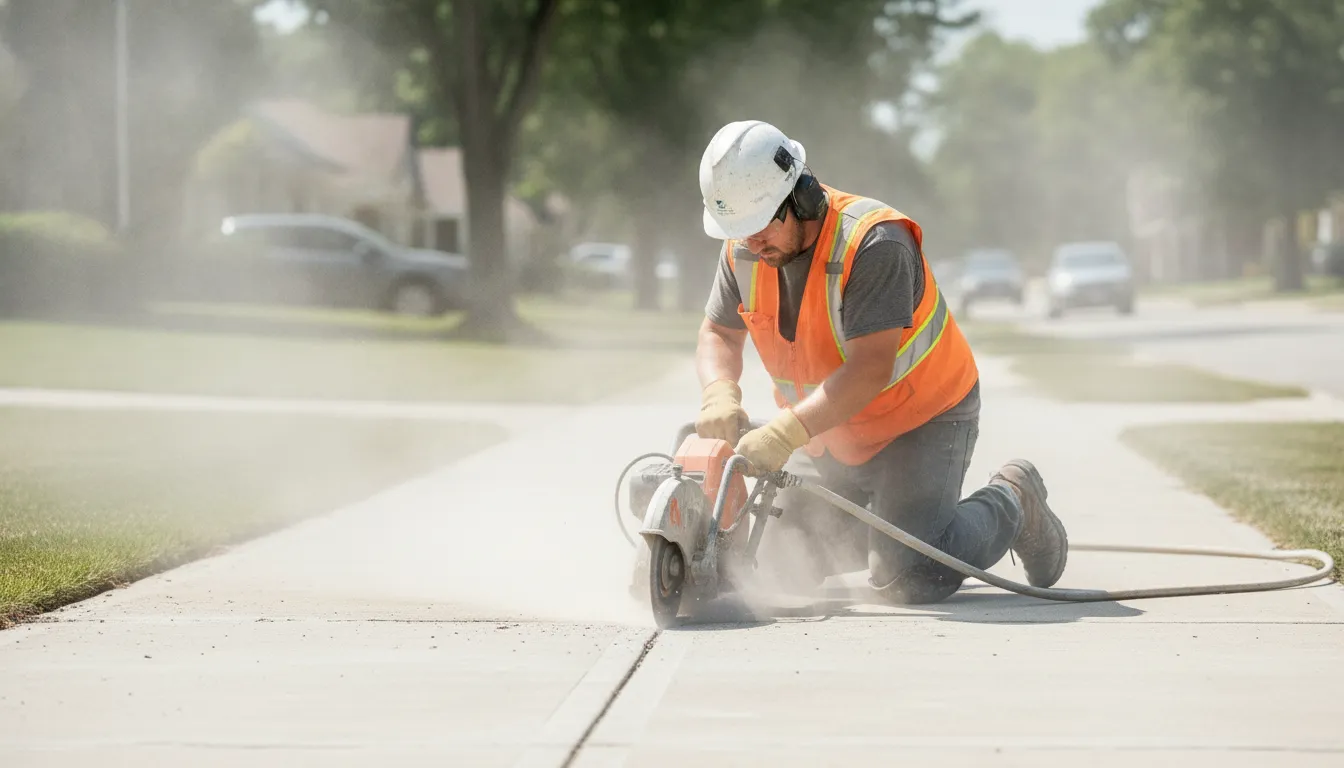
Precision cutting may be suitable for an eligible raised joint when the surrounding concrete is sound and the route can be restored safely. It is not a universal replacement for slab reconstruction. Settling, drainage, widespread surface failure, root damage, or a deficient ramp may require a different scope. The assessment should establish the condition before the board approves a remedy.
For planning purposes, compare options by expected disruption, route access, scope, documentation, and long-term maintenance needs. Avoid selecting a method based only on the appearance of one defect. The board's record should show why the chosen approach fit the observed conditions.
Build a phased repair plan
Group findings by route, priority, access impact, and operational timing. A phased plan can limit the number of routes closed at one time and make reserve discussions more manageable. Include a follow-up date for deferred items. If a complaint or accommodation request changes the priority, record the reason for the updated decision.
Boards evaluating repair approaches can review HOA sidewalk trip hazard repair planning and questions to ask HOA concrete repair contractors. Those pages can help frame scope and documentation conversations without promising that one repair method fits every property.
What Happens If an HOA Is Found Non-Compliant With ADA?
Short answer: The response depends on the property, facility, applicable law, and facts of the complaint. An HOA should avoid declaring itself compliant or non-compliant based on one measurement alone. It should preserve the report, investigate the route, obtain qualified advice, address known hazards, and document the action taken.
Potential consequences can include resident complaints, accommodation disputes, demand letters, insurance questions, repair costs, or formal proceedings. The outcome depends on the governing standard and the specific facts. A board should not rely on a blog article as a legal opinion, especially when a demand, lawsuit, government inquiry, or disputed accommodation is involved.
A documented response process is still valuable. A board can identify who received the complaint, inspect the reported location, record conditions, communicate next steps, authorize an appropriate remedy, and verify completion. Consistent records help the association explain its decision-making and identify recurring maintenance patterns.
Use recognized sources and local guidance
The U.S. Department of Housing and Urban Development fair housing resources can provide useful federal context, while state and local requirements may add obligations. HUD's NSPIRE inspection resources are another reference for covered housing programs, not a universal rule for every HOA. Confirm applicability with qualified counsel or an accessibility professional.
A Practical HOA ADA Compliance Sidewalk Requirements Checklist
Use this checklist to turn the discussion into a repeatable maintenance process:
Map common-area sidewalks, ramps, entrances, parking connections, and amenity routes.
Identify the party responsible for each segment and note public right-of-way boundaries.
Measure clear width, slope, level changes, surface conditions, and route continuity.
Photograph and location-code each finding using consistent records.
Prioritize hazards by condition, route importance, use, complaints, and resident impact.
Obtain legal or accessibility guidance when the applicable standard is unclear.
Prepare a board-ready scope, schedule, access plan, and communication notice.
Keep approvals, contractor records, before and after photographs, and closeout notes.
Schedule follow-up inspections for completed and deferred items.
When an HOA treats sidewalks as a managed community asset, compliance planning becomes more organized. The board can make decisions from documented conditions, communicate with residents more clearly, and coordinate repairs with less disruption.
Frequently Asked Questions
Do HOAs have to meet ADA standards on private community property?
Not every private HOA walkway is governed by the same federal ADA provision. Coverage depends on property use, facility access, ownership, and applicable law. Regardless of classification, the board should inspect shared routes, address known hazards, and obtain qualified advice when a complaint or accessibility question arises.
What are the most important sidewalk measurements for an HOA?
Review clear width, cross slope, running slope, surface condition, curb-ramp transitions, and vertical level changes. Common ADA reference points include 36 inches of clear width and a 2 percent maximum cross slope for accessible routes. The correct application depends on the route and governing standard.
How often should an HOA inspect community sidewalks?
There is no single schedule for every community. Set an interval based on property size, route use, climate, tree growth, prior defects, construction, and resident reports. Inspect after major weather or nearby work, and record the reason for the schedule so the board can adjust it as conditions change.
Can precision cutting replace a damaged sidewalk panel?
Precision cutting is not a universal replacement for slab reconstruction. It may be suitable for an eligible raised joint when surrounding concrete is serviceable and the route can be restored safely. A site assessment should determine whether cutting, panel replacement, drainage work, or another remedy is appropriate.
What should an HOA keep after a sidewalk repair?
Keep the original finding, location ID, photographs, measurements, board decision, contractor scope, completion date, after photographs, invoice, and follow-up review. If the work was phased, retain the open-item list and next review date. Organized records help future board members understand what was corrected and what remains.
Build a Safer, Better-Documented HOA Sidewalk Plan
HOA ADA compliance sidewalk requirements are easiest to manage when the board combines route inspection, objective measurements, clear priorities, documented approvals, and follow-up verification. That approach supports resident access and safety while helping the association plan repairs with less disruption to homeowners.



Comments