HOA Reserve Fund Sidewalk Repair Planning Guide
Updated: Oct 8
For HOA boards, hoa reserve fund sidewalk repair planning starts with treating sidewalks as community assets rather than waiting for a resident complaint. Document the walkways, confirm responsibility under the governing documents and applicable local rules, and give sidewalk work a clear place in the multi-year reserve study. Use the HOA Sidewalk Safety, Liability, and ADA Compliance Planning guide for the broader safety framework.
Good reserve planning combines a current sidewalk inventory, condition and trip-hazard records, realistic repair timing, and cost scenarios that can be updated as conditions change.
A board-ready assessment can make those decisions easier to explain to residents and easier to phase across budget cycles. It can also distinguish precision cutting opportunities from areas that may require more extensive concrete work, without treating an early estimate as a quote.
The first step is making sure sidewalks are visible in the reserve plan as their own component, with the useful life, responsibility, and funding assumptions clearly documented.
Why Sidewalks Should Be a Dedicated Line in Your HOA Reserve Fund
Sidewalks deserve a dedicated reserve line when the association is responsible for maintaining them because the line connects a distributed. Aging asset to its condition, useful life, and future repair needs. Precision Concrete Cutting can help boards organize that information through a documented sidewalk safety assessment, but the association should confirm its legal and financial responsibilities independently.
Sidewalks are easy to overlook because they are spread throughout a community rather than concentrated in one visible structure. A dedicated line keeps repairs from becoming miscellaneous expenses handled only after complaints. It also gives the board a consistent place to record the condition of paths, crossings, entries, and other walkable areas.
A reserve study commonly identifies major common elements, estimates their remaining useful life, and schedules anticipated maintenance, repair, and replacement expenses. Sidewalks may fit that framework when the association is responsible for them. Nevada reserve-study guidance illustrates these planning elements, but it is not a universal rule for every HOA. Reserve obligations vary by jurisdiction, declaration, bylaws, easements, and other governing documents.
Confirm responsibility before assigning the budget
Start with the declaration, plat, maintenance matrix, easements, and recorded agreements that define common elements. Check whether the association, individual owners, a master association, or a public entity maintains each sidewalk segment. Then confirm the interpretation with the association's attorney, reserve-study professional, or relevant local authority. A board should document the basis for its conclusion rather than assume that public access or location determines responsibility.
What the dedicated line should track
A useful line is more than a dollar amount. It should connect the physical inventory to a practical work plan:
- Inventory:
identify sidewalk segments, panels, paths, crossings, and other walkable areas within the association's responsibility.
- Condition:
record trip hazards, cracking, settlement, drainage concerns, accessibility observations, and the severity and location of each issue.
- Useful life:
estimate how long each asset or repair approach may serve, while recognizing that site conditions affect the result.
- Timing:
assign inspection dates, anticipated intervention windows, and the budget cycle in which work may occur.
- Repair path:
distinguish precision cutting or other targeted repairs from areas that may require broader replacement, based on an actual assessment.
This structure helps the board compare current conditions with future funding needs and explain priorities to residents. For a practical operating framework, review HOA Sidewalk Safety, Liability, and ADA Compliance Planning. That related guide complements this article's reserve-fund focus.
How HOA Reserve Fund Sidewalk Repair Planning Starts With Realistic Costs
HOA reserve fund sidewalk repair planning becomes more reliable when the board estimates quantities, condition, timing, and repair options before setting a contribution target. Precision Concrete Cutting can provide a site-specific assessment and scope. While the board should treat every early figure as a planning estimate until the work is inspected and priced for its actual conditions.
Effective reserve planning requires realistic assessments of both the timing and cost of anticipated major repair and replacement work. Reserve-planning guidance provides one jurisdictional example, not a universal rule. Use the following sequence to build a transparent model:
- Map every sidewalk panel and visible hazard.
Inventory paths, crossings, and other pedestrian concrete that the association is responsible for maintaining. Record each raised joint, crack, settlement area, spall, or deteriorated panel. A map prevents the board from budgeting from memory.
- Classify condition and priority.
Note pedestrian traffic and proximity to entrances, mail areas, pools, parking, playgrounds, and other heavily used spaces. This creates a defensible priority list instead of treating every panel as equally urgent.
- Estimate quantities before applying prices.
Count panels or measure repair areas in each condition category. Request pricing against those quantities instead of applying a broad per-square-foot assumption to the entire community.
- Model precision cutting and full replacement separately.
Create a scenario for panels that may be addressed through PCC's non-invasive precision cutting process and another for areas that genuinely require demolition and replacement. PCC states that its process costs on average 80% less than demolition and replacement. These are customer-provided planning figures, not universal market prices or a guaranteed quote. Site condition, access, scope, and local labor can change the result.
- Set timing assumptions.
Assign each work category to a realistic year or budget cycle. Schedule urgent hazards first, then plan lower-priority work before deterioration increases the scope. The Federal Highway Administration notes that proactive maintenance can extend pedestrian-facility service life and reduce the need for costly reconstruction or replacement.
Refresh quotes and document contingencies.
Record quote dates, quantities, exclusions, access assumptions, and possible drainage, engineering, traffic-control, or replacement needs. Include a clearly labeled contingency. For a deeper board-level review, use this guide to
.
Keep the calculation trail with the reserve study: inventory map, condition ratings, quantity takeoff, scenario pricing, schedule, quote sources, and contingency rationale. When assumptions change, update the model instead of allowing an old estimate to appear precise.
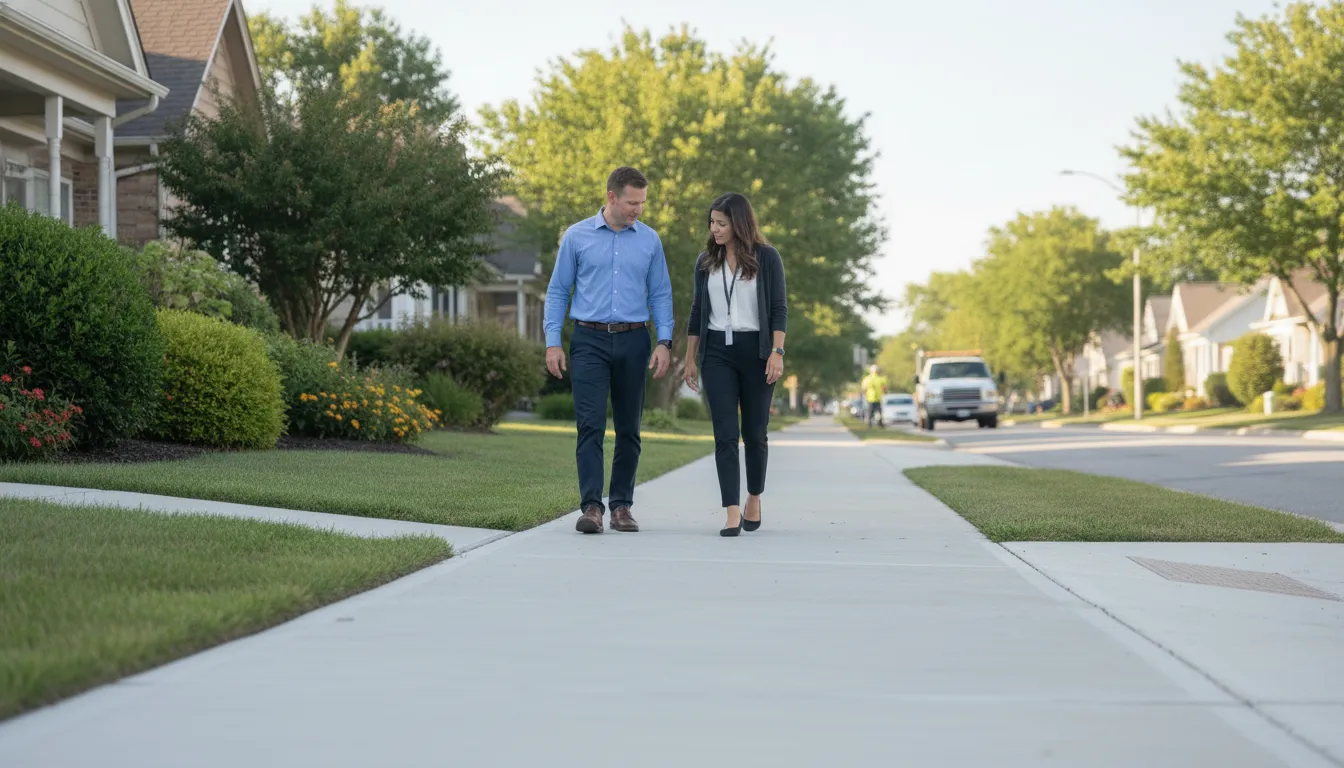
A documented condition assessment gives an HOA board a practical starting point for reserve planning.
How Often Should an HOA Reserve Study Include Sidewalk Re-Inspection?
Sidewalk re-inspection should match the condition, use, and exposure of the community's walkways, then feed current information back into the reserve study. Precision Concrete Cutting recommends using condition data to help boards prioritize work, but there is no single interval that fits every HOA.
Use walk-throughs for ongoing observation
Board members, managers, and residents may notice a raised joint, cracked panel, drainage issue, or route that has become difficult to navigate. An annual walk-through, plus reviews after major weather events, gives the association a practical way to record visible changes. Cover high-traffic routes, pool and clubhouse approaches, parking connections, mail areas, and routes used by residents with mobility limitations.
These observations are not a substitute for a professional survey. Record the location, photograph the condition, note whether the issue is recurring, and compare it with prior records. A repeat complaint or rapidly changing defect deserves closer assessment rather than waiting for the next scheduled reserve-study visit.
Schedule professional surveys when conditions change
A professional condition survey can provide a systematic inventory and a defensible basis for prioritizing work. Survey sooner when deterioration is progressing, severe weather has affected the property, nearby construction may have shifted concrete, or recurring trip hazards appear. Minnesota DOT pedestrian-asset research describes deterioration as progressive and emphasizes systematic assessment with prioritized intervention.
For a stable, well-documented community, a survey may align with the reserve-study cycle. For aging concrete, drainage problems, tree-root movement, or repeated repairs, waiting several years can leave the board working from outdated conditions. Ask whether new data would change priorities, schedule, or funding decisions. For ongoing maintenance context, see the maintenance principles discussed earlier in this article.
Update the formal reserve study when assumptions change
Update the reserve study when a professional survey shows materially different conditions, after a major repair or construction project, or when useful-life and cost assumptions change. The Nevada reserve-study standard describes component condition, remaining useful life, and estimated expenses as core planning information. Keep walk-throughs, professional surveys, and the formal study connected.
What Happens When an HOA Under-Reserves for Sidewalk Repairs?
Under-reserving can turn a manageable sidewalk repair list into a less predictable backlog, forcing the board to weigh safety, timing, funding, and resident communication at the same time. Precision Concrete Cutting can help an association evaluate targeted repair opportunities, but a current inventory and qualified financial advice remain essential to the board's decision.
Deferred hazards create a less predictable backlog
When funding is limited, the board may postpone lower-priority work while additional hazards develop between inspection cycles. The Federal Highway Administration notes that proactive maintenance can extend pedestrian-facility service life and reduce the need for costly reconstruction or replacement. That is a planning rationale, not a promise of a specific savings amount. A current inventory showing location, condition, severity, and likely timing makes decisions more deliberate.
A practical sidewalk risk register can help the board see which areas deserve attention first. Record hazard severity, pedestrian traffic, access needs, inspection dates, and the reason for each priority. This does not eliminate uncertainty, but it reduces reliance on the loudest complaint.
Budget volatility affects residents and board decisions
If several repairs become urgent in the same budget cycle, the association may face a larger expenditure than anticipated. That can affect reserve contributions, project timing, and the board's explanation of why other work is changing. Reserve planning should include expected maintenance and unexpected repair needs, while accounting requirements vary by governing documents and jurisdiction.
Clear communication matters when funding is limited. Residents are more likely to understand a phased program when the board can show inspection findings, explain safety and traffic priorities, and identify what is scheduled next. Proactive maintenance may reduce pressure for a special assessment, but it cannot guarantee that an assessment will be avoided. Review the reserve study and legal obligations with qualified advisers.
Urgent procurement can reduce planning flexibility
A sudden repair need can compress contractor selection, board approval, resident notice, and scheduling. Building sidewalk condition data into the reserve plan gives the board more time to compare repair and replacement scenarios, schedule phases, and communicate expectations before conditions become urgent.
Phased Repair Programs: Spreading Costs Without Sacrificing Safety
A phased program does not mean accepting unsafe walkways until the budget improves. It means ranking documented needs, addressing consequential hazards first, and scheduling lower-risk work in a way the board can fund and oversee. For an HOA, this approach can turn a long sidewalk backlog into a manageable reserve-fund plan.
Start with a current condition assessment. Record each trip hazard, its location, surrounding surface condition, and likely repair or replacement treatment. Score each location against hazard severity, pedestrian traffic, location, deterioration, and budget timing. A raised panel beside a clubhouse entrance, mailbox area, pool route, or other heavily used path may warrant earlier attention than a similar defect on a low-use walk
Priority framework for phased HOA sidewalk repairs
Immediate: Address severe hazards on high-traffic routes or critical access points. Planning treatment: Confirm the schedule, funding, and any temporary access plan.
Near term: Repair moderate hazards, worsening deterioration, and defects on regularly used routes. Planning treatment: Place work in the next budget cycle with an itemized scope and current cost assumptions.
Planned: Address lower-severity defects where deterioration is stable. Planning treatment: Group locations into an efficient project package within the study horizon.
Monitor: Track minor defects without a significant current access or trip concern. Planning treatment: Document the location and move it forward if conditions change.
way.
Prioritization based on traffic and hazard severity helps limited funds produce meaningful safety improvements. The Federal Highway Administration also notes that proactive maintenance can extend pedestrian-facility service life and reduce the need for costly reconstruction or replacement. These principles support spreading work across budget cycles, but they do not justify delaying a severe or rapidly worsening hazard.
After each phase, verify the completed work. Update the location, treatment, completion date, photographs, and remaining observations in the sidewalk inventory. Re-rank the backlog at least annually and sooner after severe weather, construction, drainage changes, or a new inspection.
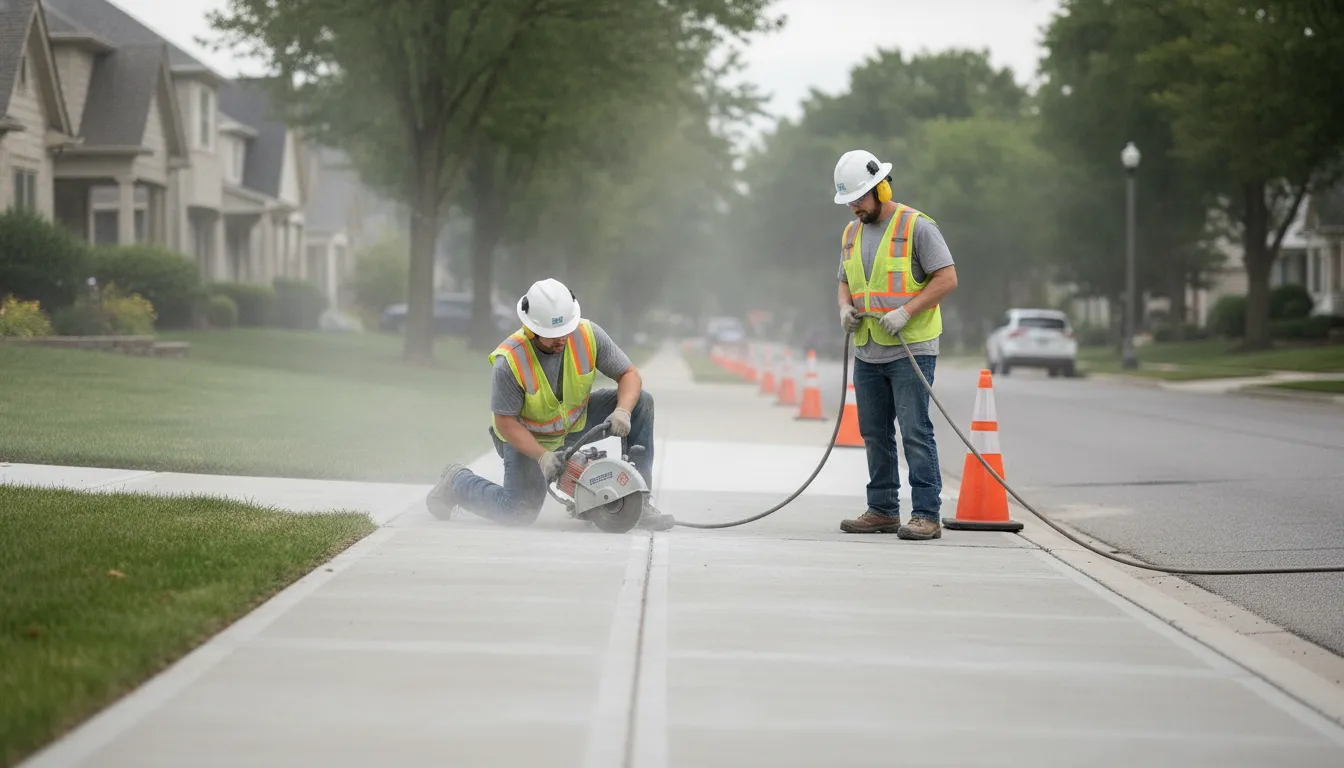
Targeted precision cutting may be one repair scenario to evaluate during reserve planning.
How Board-Ready Documentation Supports HOA Reserve Decisions
Board-ready documentation supports an HOA reserve decision by showing what needs attention, where it is located, how serious it is, and what action is recommended. Precision Concrete Cutting positions its assessment and GIS reporting as a way to organize sidewalk assets for planning. While the board should confirm the final scope and compliance interpretation for its community.
Build a complete record of the sidewalk assets
Inventory sidewalks, walkways, entries, ramps, and other concrete areas the association may be responsible for under governing documents and applicable local rules. Identify each area, note its approximate size or panel count, and connect it to a recognizable location. Describe vertical displacement, cracked panels, deteriorated edges, drainage concerns, and accessibility observations. Dated photographs help the board compare conditions during future inspections.
Connect field observations to reserve actions
GIS maps and reports can organize records by building, walkway, phase, or priority. PCC describes its GIS documentation as board-ready and useful for organizing sidewalk repairs and ADA-related records. A map can show each item, while a report can summarize condition, recommended scope, priority, and planning assumptions.
Accessibility observations should be documented carefully. ADA transition-plan materials commonly address schedules and funding for improving pedestrian infrastructure, but requirements and responsibilities vary by jurisdiction, property type, and governing documents. For an HOA, record relevant observations and obtain guidance appropriate to the community before labeling a condition a compliance violation. See the HOA concrete repair contractors guide when evaluating who can translate findings into a repair scope.
Make approval and communication part of the record
A board packet can include the map, photographs, condition summary, estimated timing, proposed repair method, and explanation of why work is prioritized. Capture the approval, selected scope, funding source, and any decision to phase the work. After completion, retain the final repair record, updated photographs, project documentation, and areas that still require monitoring.
Residents do not need every technical detail. Clear documentation helps explain which walkways are being addressed, why the sequence was chosen, and how the work supports safety and responsible reserve planning.
Frequently Asked Questions About HOA Sidewalk Reserve Planning
What is an HOA reserve fund used for in sidewalk repair planning?
A reserve fund sets aside money for anticipated maintenance, repairs, and replacement of major common elements, including sidewalks when the association is responsible for them. Confirm responsibility in the governing documents and applicable local rules, because reserve obligations vary by jurisdiction. A sidewalk line helps the board plan for expected maintenance and unexpected major repairs.
How should an HOA estimate sidewalk repair costs?
Start with an inventory of sidewalk segments, current condition, quantity of work, and likely timing. Compare repair and full replacement scenarios, then refresh assumptions as conditions and prices change. Pricing varies by region and site, so any figure should be treated as a project estimate rather than a universal price.
When should an HOA update its reserve study for concrete maintenance?
Review the study when a professional inspection shows changing conditions, deterioration accelerates, significant weather or construction affects the property, or project costs change materially. Annual walk-throughs identify emerging issues, while periodic professional assessments support more reliable condition and cost assumptions.
Are sidewalk trip hazards an emergency or a planned reserve expense?
It depends on hazard severity, location, pedestrian traffic, and the association's response procedures. Document urgent hazards and address them promptly, while placing lower-risk work into a phased program based on severity, traffic, and available budget. Proactive maintenance can support longer service life, but it does not replace a timely response to a severe condition.
Can reserve-funded sidewalk work include ADA documentation?
Yes, a repair plan can include measurements, condition records, maps, photographs, completed-work records, and other documentation relevant to accessibility. Exact requirements depend on jurisdiction, property, and governing documents. Board-ready GIS maps and reports can support approval, resident communication, and an organized compliance record.
For a board that wants to replace assumptions with current condition data, a sidewalk safety assessment is a practical next step. It can help connect the repair backlog, likely treatment, timing, and documentation to the reserve discussion.
Related reading: sidewalk repair budgeting for property managers.



Comments