Sidewalk Repair Scope of Work Template: A Buyer's Guide
Updated: Oct 12
Vague sidewalk repair plans lead to budget bloat and missed compliance deadlines. A structured template helps property managers secure better bids and lasting results. It defines the tasks required to bring walkways back to safety.
A sidewalk repair scope of work is a formal document that lists the exact tasks, parts, and standards needed to fix concrete defects. This guide helps property managers and HOAs get clear bids by defining exactly how a contractor should handle trip hazards and cracks. It must include site details, repair methods like precision concrete cutting, and strict adherence to federal rules. For example, the ADA Standards for Accessible Design state that any vertical lift over 1/4 inch needs proper treatment to ensure safety. Using a clear template prevents costly change orders and ensures the project meets all safety codes. It also allows buyers to choose cost-effective options like precision cutting over full slab replacement. This clarity protects the owner from liability and ensures long-term sidewalk health.
Call 877-224-0025 to schedule a free sidewalk assessment and get a scope of work tailored to your property.
Property managers must understand the core parts of this document to save time and prevent repair failures before starting the bidding process. This guide walks through every section you need to build a complete sidewalk repair scope of work template.

What Is a Sidewalk Repair Scope of Work?
A sidewalk repair scope of work is a formal list of tasks for a concrete project. It tells a crew what to do and what rules to follow. Without this plan, bids from different teams may not match. This makes it hard to compare costs in a fair way. A clear scope of work helps property managers and HOA boards get the best results for their budget.
Most property owners must fix the paths on their land. In 28 of the 30 largest U.S. cities, sidewalk repair costs fall on the owner. A full scope of work stops you from paying for extra tasks later. It sets clear rules for safety and quality from the start.
Who needs a repair scope?
Property managers use these plans to keep sites safe and avoid risks. HOA boards use them to plan for repairs and save community funds. Public works teams also use them to manage city paths and assets. Since ADA compliance is a federal rule, every scope must list clear safety goals. A good plan stops errors and keeps the work on track. If you manage multiple properties, you can learn more about our trip hazard removal services for multi-site portfolios.
Why a written plan helps
A written scope stops costs from growing after work starts. It also makes sure every team bids on the same tasks. You should list specific ways to fix the concrete in your plan. For example, specify precision cutting steps to remove trip hazards without the mess of full replacement. Using a set list of tasks helps you track how the work goes. You can check the job against the plan before you pay. This protects your site and ensures the paths are safe for all.
Key Elements Every Sidewalk Repair SOW Should Include
A clear sidewalk repair scope of work protects your property and your budget. It tells the contractor exactly what to do and how to do it. Without these details, you may get poor results that fail to meet safety codes. Use the steps below to build a full plan for your next repair project.
Project site info and scope
Start with a clear list of where the work will happen. Note the exact addresses or areas on your property that need help. You should also describe the main goals of the project. For example, state if you want to remove trip hazards or fix cracked slabs. This helps the team plan their tools and staff for the job.
Compliance and code standards
Your plan must follow the law to keep people safe. The ADA Standards for Accessible Design set strict rules for walkways. Vertical changes up to 1/4 inch can stay as they are without extra work. But if a lift is between 1/4 and 1/2 inch, the law says you must bevel the edge at a 1:2 slope. Your SOW should list these ADA sidewalk compliance standards to ensure the site stays compliant.
- Project site info:
List the exact site location and the limits of the work area. Include a map if the property is large.
- Detailed scope:
Explain the work to be done. State if you need precision cutting for trip hazards or full slab replacement.
- Materials and methods:
Define what materials the team must use. Mention that they should place expansion joints at 20-foot intervals to prevent future cracks.
- ADA compliance:
Require all work to meet local and federal codes. Include rules for cross slopes and beveling for vertical lifts.
- Schedule and timeline:
Set a clear start and end date. Ask for a plan that limits how much the work blocks foot traffic for your tenants or residents.
- Acceptance criteria:
State how you will check the work before you pay. Note that all repairs must be smooth and free of debris.
- Insurance and liability:
Ask for proof of insurance and a list of safety protocols. This protects your property from risks during the job.
Acceptance and signatures
End the document with a section for final signs. This makes the SOW a binding part of your contract. It ensures both you and the contractor agree on the quality of the work. Clear terms here will help you avoid disputes and ensure your walkways are safe for everyone.
Understanding ADA Compliance Requirements in Your SOW
Your sidewalk repair scope of work must put safety and the law first. The Americans with Disabilities Act (ADA) sets strict rules for how paths must look and feel. If you miss these rules, you face high legal risks. A good plan shows your team how to fix trip hazards so they meet these goals. You should focus on clear numbers to keep your property safe for all people. Stating these rules early ensures the work meets federal needs.
Managing vertical lip shifts
The most common issue in sidewalk care is the vertical lip. This shift happens when one slab sits higher than the next one. Per ADA standards, any lift up to 1/4 inch is fine without a fix. But once the gap grows, you must act to remove the risk. If the lift is between 1/4 inch and 1/2 inch, the law says you must bevel the edge. This bevel must have a slope no steeper than 1:2 to ensure a smooth path for feet and wheels.
Precision cutting is the best way to meet these ADA sidewalk compliance standards. Some teams try to use grinding, but that method often leaves a rough and uneven finish. Cutting removes the full lip across the whole width of the slab. This makes sure the path is flat and easy to walk on. If a shift is over 1/2 inch, you may need to replace the full slab to stay safe. Your plan should state how each gap size will be fixed to stay in line with federal rules.
Slope and grade limits
Walkways must be level from side to side. The cross slope is the angle across the width of the path. To stay safe, the cross slope should not be more than a 2 percent grade. This tilt helps water run off but keeps the path easy for people in chairs to use. If the slope is too steep, it can cause a chair to pull to one side. This makes the path hard to use and creates a new risk for your site.
The running slope also matters for long sidewalk paths. This is the grade along the length of the walk as people move forward. In areas that are not ramps, this grade should stay under 5 percent. Your scope of work needs to list these limits so the crew knows what to check. The Access Board states that firms should follow industry standard tolerances when they do this work. This means the final build must be as close to the target numbers as possible.
Setting clear inspection rules
A solid work plan also tells the team how to prove they did the job right. You should ask for a final check of all repairs once they are done. This check should look at the height of each joint and the slope of the path. You want to see that every trip hazard is gone. When you have clear data, you can show that your property follows all rules. This helps when you talk to insurance firms and keeps your site in top shape for many years.
How to Choose Between Repair Methods: Cutting vs. Replacement
When you build a sidewalk repair scope of work, you must decide which method fits your site best. Most projects use either full concrete replacement or precision concrete cutting. Both paths aim to meet ADA standards for safety, but they differ in cost, speed, and impact on your residents.
Comparing Speed and Impact
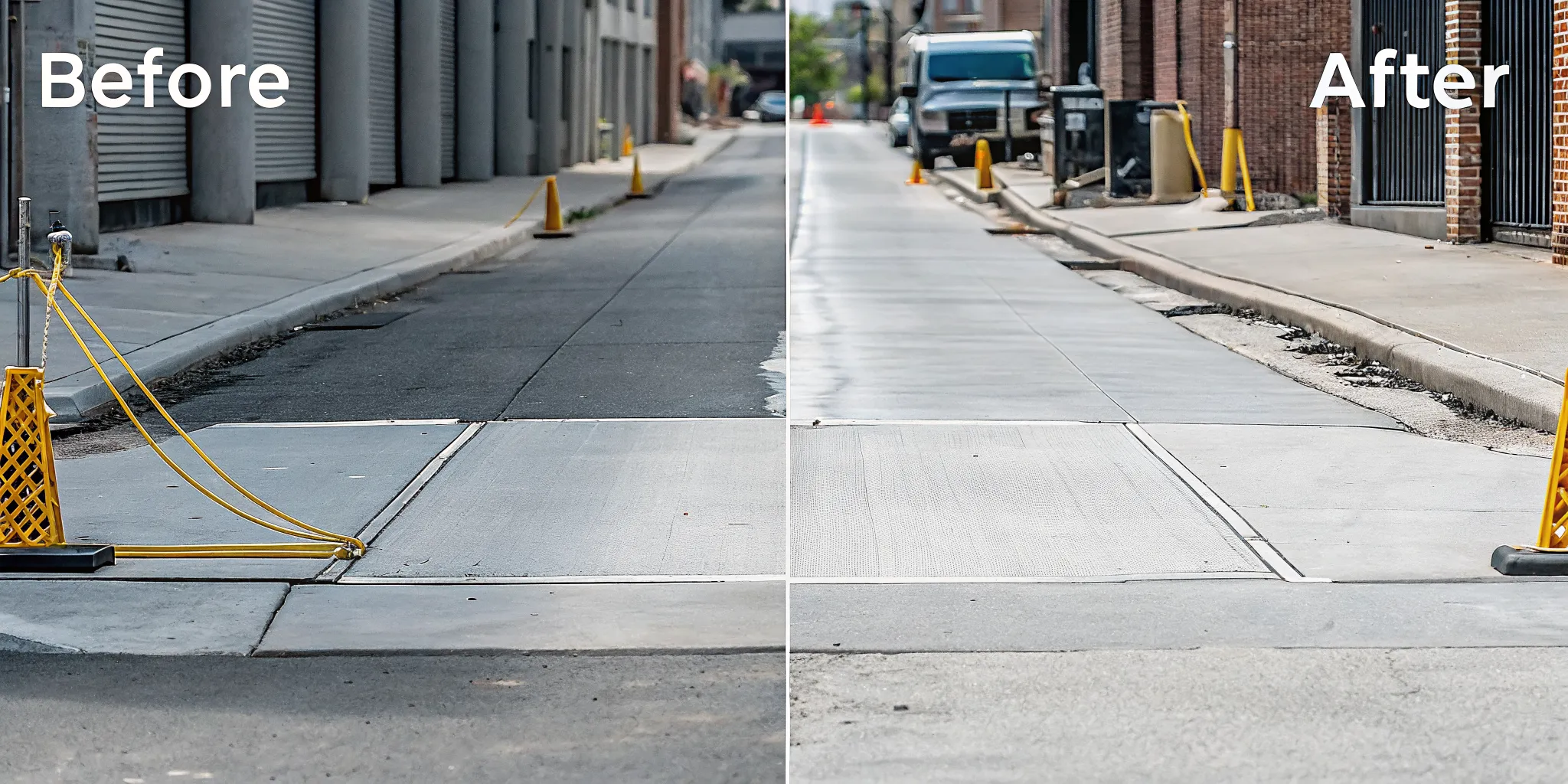
Precision concrete cutting is a patented process that removes trip hazards without the need for big machines. This method is much faster than full replacement. A crew can often finish a whole block in one day. For property managers and HOAs, this means less noise and no closed paths for days at a time. It also avoids the high cost of new items and the waste of moving old concrete to a dump.
Full concrete replacement means breaking up the old slab, hauling it away, and pouring new mix. This path is often needed when the concrete has deep cracks. But it takes more labor days and creates more noise for tenants. Before you set your concrete repair costs, think about how each choice affects the daily life of your group.
Key Differences for Success
The choice often comes down to the goal of the work. If your main task is to remove a trip hazard, cutting is the best path. It leaves an ADA-compliant slope by cutting the concrete at an exact angle. If the goal is to fix deep issues like root damage, replacement might be the only way. Most modern sidewalk repair standards favor the easiest path that still keeps people safe. For more details on how precision cutting compares, read about trip hazard removal methods.
Criteria | Precision Cutting | Full Replacement |
Project Cost | Lower (saves about 80%) | Higher (labor and cost) |
Time to Finish | Hours or one day | Many days or weeks |
Site Noise | Low; no closures | High; paths closed |
Concrete Waste | None; dust is saved | High; old slabs removed |
ADA Outcome | Full safety reached | Full safety reached |
Life Span | Lasts as long as the slab | New slab life (20+ years) |
Green and Social Gains
Using precision cutting is a greener choice for your land. It does not need new cement, which can hurt the air. Since the work is quiet, it keeps resident stress low. Property managers often prefer this path because it fixes the risk fast and keeps the cost low while still meeting ADA rules for vertical changes in level.
Common Mistakes When Writing a Sidewalk Repair SOW
Writing a sidewalk repair scope of work (SOW) seems simple but often leads to costly errors. Many buyers use vague terms that fail to hold crews to a high standard. This lack of detail causes disputes, poor results, and extra costs. Avoiding these common traps helps ensure your walkways are safe and meet legal rules.
Using vague scope language
One major error is using weak words like "repair as needed." These phrases are too broad. They give the crew too much control over the job. Without a clear list of spots and tasks, you may face change orders that blow your repair budget for sidewalks. A good SOW maps every trip hazard by its exact spot and size. It also states the exact repair method to use for each one. This level of detail keeps bids fair and prevents hidden fees later in the project.
Failing to cite specific ADA standards
Your SOW must name the exact rules for sidewalk safety. Many buyers forget to mention the 1/4-inch vertical displacement rule. The ADA Standards for Accessible Design state that vertical changes up to 1/4 inch may stay vertical without extra work. However, changes between 1/4 inch and 1/2 inch must be beveled with a slope no greater than 1:2. You should also note that the max cross slope is a 2% grade. The Access Board recommends using industry standard tolerances when specific specs are missing. Citing these ADA sidewalk standards protects you from legal risks and ensures the work passes inspection.
Skipping acceptance criteria and inspection data
A scope of work is useless if you cannot reject poor work. Many SOWs lack clear acceptance criteria. You should require the contractor to prove each repair meets the 1/4-inch rule. Do not just take their word for it. Ask for post-repair inspection data for every slab. This data should show the slope, height, and finish of the repair. If the crew fails to provide this proof, you should have the right to withhold pay. This keeps the quality high and gives you a clear record for your files.
Ignoring repair methods and phasing
Choosing the wrong repair method is a big mistake. If you do not specify precision cutting, a crew might use grinding. Grinding often leaves a rough, unsafe finish that does not meet ADA rules. Precision cutting is a better choice because it is fast and clean. You also need a clear timeline and phasing plan. This is vital for property managers with multi-site portfolios. A phasing plan helps you manage resident traffic and keeps the project on track. Lastly, ensure the SOW lists all insurance and liability needs to protect your property during the work.
How to Use an SOW to Get Accurate Bids
A clear sidewalk repair scope of work helps you get fair prices from vendors. When you use the same document for every bidder, you can compare their offers with ease. Contractors need specific details to give you a firm number. Without a good SOW, you might face extra costs or delays later in the project.
Fair comparisons for your project
Using a standard SOW lets you see "apples-to-apples" results. If each team bids on a different plan, you cannot know who offers the best value. A detailed SOW ensures that every vendor accounts for the same site access, concrete mix, and cleanup rules. This consistency is vital for your budget and helps you avoid low-ball bids that skip key steps.
What contractors look for in your SOW
Pro crews want to know exactly what the job entails before they sign. They look for the total number of trip hazards and the repair method you want. You should state if you prefer precision cutting or full replacement. The ADA Standards for Accessible Design require vertical changes over 1/4 inch to be fixed. Listing these goals in your SOW tells the crew you know the rules. It also shows them you expect high-quality work that meets federal law. For a sample RFP process, review our municipal sidewalk repair RFP guide.
Clear terms for better results
Your SOW should also list your timeline and payment terms. Contractors need to know when they can start and how fast you need the work done. If you have many sites, tell them how to move between locations. Good data helps a pro plan their crew and tools. When they have all the facts, they can give you a bid that stays true. This leads to a smooth project with no surprises for your team or your board.
Frequently Asked Questions
What are the industry standards for sidewalk repair tolerances?
When your scope of work lacks clear rules, you should rely on trade norms. The Access Board states that firms must use industry standard tolerances in these cases. This helps you keep the work good when clear rules are missing. Adding these terms to your contract protects you from poor work and ensures your paths stay safe for all users.
Who is responsible for sidewalk repairs?
Most property owners are held at fault for the paths next to their land. While the city often owns the right of way, laws in most big U.S. towns place the cost of repair on the owner. You should check your local code to see who must pay for upkeep. Planning for these costs in your yearly budget helps you avoid sudden fees and legal risks.
Are patch repairs allowed for sidewalk defects?
Patching concrete is often not a legal fix for large gaps or breaks. For instance, some city rules ban patching any slab that has deep cracks or holes. Instead, you must fix the whole square or use a repair method that meets ADA standards. Many buyers now use precision cutting to remove trip hazards without the high cost of a full new slab.
How do you prioritize sidewalk repair work?
You should rank your repair needs by safety risk and law rules. Start by finding areas with the most foot traffic and the worst trip hazards. These spots pose the highest risk for falls and legal claims. Using GIS-based mapping tools helps you map out every defect and plan your work in stages. This data-led path makes sure you spend your budget where it helps the most people.
What is the typical slope standard for sidewalk repairs?
Most local codes require a clear slope to keep paths safe for wheelchairs. A common rule is a lowest slope of one inch in five feet. However, these rules can change based on your city. You should list these slope needs in your scope of work to ensure the new surface meets ADA rules. This helps you avoid rework and extra costs later on.
Ready to schedule a free sidewalk assessment?
Leaving sidewalk trip hazards alone creates a high risk for your property. Broken paths often lead to costly law suits and injury fines. These costs can hurt your bottom line for many years. When you act now, you stop small cracks from turning into high cost repairs. This helps keep your walkers safe on every walkway you manage. You will also stay within your budget and avoid price hikes. Our precision cutting process saves you both time and money. It helps you meet all safety rules so you can get back to work with total peace of mind.
Ready to get started? Call 877-224-0025 to talk to a sidewalk safety expert and get your free assessment.




Comments