HOA Board Approval Sidewalk Repair: A Practical Guide
Updated: Oct 12
Board takeaway: A successful HOA board approval sidewalk repair request connects each walkway condition to a documented priority, defined scope, funding source, schedule, and specific vote. A community manager or board member can use this process to replace a general complaint with a practical capital-planning decision. For the broader framework, review HOA sidewalk safety, liability, and ADA compliance planning.
Sidewalk work can affect common property, resident access, reserve planning, and association contracts. The board needs enough information to decide what should be repaired, how the work should be funded, and whether the proposed schedule is realistic. This guide focuses on that decision process without assuming that every HOA has the same governing documents or maintenance obligations.
Why HOA Board Approval Sidewalk Repair Often Requires a Full Board Vote
Answer: Sidewalk repairs often need a full HOA board vote because they may affect common property, resident access, reserve funds, and vendor contracts. A vote is not automatic in every association. The declaration, bylaws, maintenance matrix, applicable law, prior resolutions, and board spending authority determine who may approve the work.
Many associations treat sidewalks inside common areas as association assets. That can make repair a board-level decision even when a manager first receives the complaint. A small routine item already covered by an approved operating budget may fall within delegated authority. A larger project, reserve-funded repair, or work outside the approved budget may require a formal motion.
Start by identifying the decision the board must make. The request could authorize a community-wide assessment, approve a first phase, select a vendor, or approve a contract up to a stated amount. Avoid asking the board to approve vague sidewalk work with no locations, scope, funding path, or completion standard.
Responsibility must be checked before the proposal is finalized. Some walkways may be common elements, while others may involve easements, public rights-of-way, or owner obligations. If the governing documents are unclear, ask association counsel or the responsible public agency. This article is a planning resource, not a legal opinion.
Minutes should record the condition reviewed, information considered, options discussed, procurement method, approved scope, funding source, and vote. A clear record helps future boards understand why the association approved, phased, or deferred the work.
How to Build a Capital Expense Proposal for Sidewalk Repair
Answer: A capital expense proposal for HOA sidewalk repair should define locations, scope, cost, funding, schedule, access, and the requested board action. It should explain what the association will verify after completion. These details let directors evaluate a specific project instead of debating an undefined maintenance concern.
- Define the problem.
Explain whether the request came from resident reports, an inspection, visible elevation changes, or reserve planning. Identify the affected routes and the practical impact on residents, guests, staff, and service providers.
- Confirm authority.
Review the declaration, bylaws, maintenance matrix, easements, prior resolutions, and approved budget. Confirm whether the work belongs in operating maintenance, reserves, or another approved category.
- Document conditions.
Use a location list or map, photographs, condition notes, relevant measurements, and consistent priority criteria. A community-wide review is more useful than a single-panel estimate when the board needs to plan across the property.
- Request comparable scopes.
Ask each vendor to address the same locations and describe quantities, method, access controls, cleanup, timing, warranty terms, exclusions, and completion records. Comparable scopes produce a more useful comparison.
Show the funding path.
Explain the anticipated cost, available reserve or operating allocation, payment timing, and effect on other planned work. Use the association's reserve study and financial records rather than unsupported cost assumptions. The related
HOA sidewalk repair cost guide
can help frame the budgeting discussion.
- Compare the right options.
Depending on site conditions, the board may compare full replacement with targeted precision cutting for suitable trip hazards. The assessment should determine which method fits each location, not a predetermined sales preference.
- Prepare the motion.
State the approved locations or phase, maximum amount, funding source, vendor authorization, schedule conditions, and who may approve limited changes.
- Close the record.
Retain invoices, completion notes, before-and-after records, warranty information, and the updated asset inventory.
The goal is a decision packet that is specific enough to approve and flexible enough to manage normal field conditions. It should tell residents what is being addressed now, what remains, and how the association will evaluate later phases.
What Data and Documentation Supports a Sidewalk Repair Request?
Answer: A board-ready request should include a location list or map, photographs, condition notes, relevant measurements, priority criteria, comparable scopes, funding analysis, schedule, resident communication plan, and draft motion. After approval, retain the contract, invoices, completion records, and updated inventory. The packet should support responsible decisions without promising a legal or insurance outcome.
Photos can start a conversation, but they rarely answer every board question. Pair them with location details, severity notes, measurements, access information, and an explanation of what happens if work is delayed. Use the same inspection standard across the community so that priorities do not depend only on the most recent complaint.
Basic request | Board-ready request |
Several sidewalks are uneven. | Mapped locations with photos, condition notes, and a priority order. |
One total price with no assumptions. | Scope with quantities, method, access plan, schedule, exclusions, and completion records. |
Urgency based on one complaint. | Inspection findings, resident impact, safety context, and reason for the proposed phase. |
Approval with no funding explanation. | Funding source, reserve connection, timing, and effect on future work. |
For accessibility planning, measurements and standards should be handled carefully. The PennDOT sidewalk and ADA technical sheet discusses accessible widths, cross slopes, surfaces, and elevation changes. The reference can help a board ask informed questions, but it does not replace site-specific assessment or professional advice.
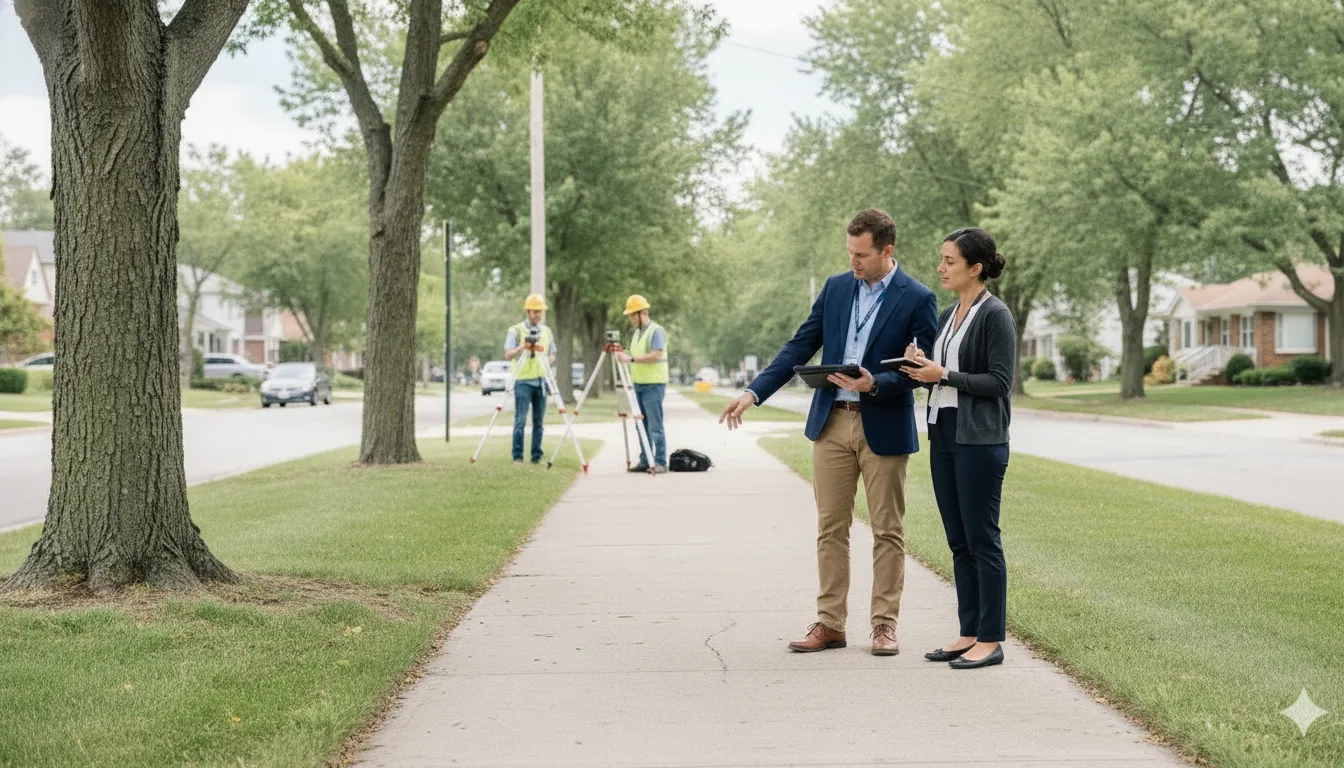
Precision Concrete Cutting (PCC) describes its service as a patented cutting process for suitable trip hazards. The appropriate repair method depends on the documented condition, surrounding concrete, access requirements, and the association's goals. Avoid promising that one method will fit every panel or eliminate every future maintenance need.
A location-based inventory can also support reserve planning. It gives the board a record of known hazards, completed work, pending work, and the next review date. When an association uses mapping or GIS-supported records, future budget discussions can begin with a shared source of information instead of scattered emails and photos.
How to Present a Phased Repair Plan Without Losing Board Confidence
Answer: Present a phased repair plan as a complete program. Define phase one, priority criteria, remaining inventory, funding path, review date, and resident communication plan. Explain what phase one accomplishes and what remains. State what evidence the board will use when deciding whether to authorize the next phase.
Phasing can match the association's available reserves, access constraints, and actual condition distribution. It should not become an open-ended promise to address the remaining work later. Begin with criteria such as condition severity, pedestrian volume, proximity to entrances, accessibility needs, repeat complaints, drainage, and mobilization efficiency.
Show three numbers whenever possible: the scope and cost of phase one, the estimated remaining inventory, and the expected review point for the next phase. Use ranges when final quantities are not known. Explain whether phase one addresses the highest priorities, tests a repair approach, or aligns with a reserve-funding milestone.
Resident communication belongs in the proposal. State which routes may be affected, how access will be maintained, when work is expected, and where questions should go. The U.S. Access Board guide to accessible routes explains how accessible routes connect arrival points and facilities. That guidance reinforces the need to plan temporary access before work begins.
For a qualified location, PCC's precision cutting approach may address a trip hazard without requiring full slab replacement. The proposal should still identify locations that need broader replacement or another treatment. A transparent method decision protects board confidence because the recommendation follows the condition rather than forcing every location into the same scope.
End the phase plan with completion criteria. The manager should receive completed locations, inspection notes or photographs, invoices, warranty information, and updated asset data. The board can then compare the approved scope with the delivered work and decide whether the next phase should proceed.
How Can Boards Address Common Objections to Sidewalk Repair Spending?
Answer: Address objections with documented alternatives rather than pressure. Show what can wait, what should be prioritized, what full replacement and targeted repair would include, how residents will be affected, and how results will be verified. A transparent comparison helps directors make a defensible decision within their authority and explain the chosen scope to residents.
Can this wait until next year?
Answer with a priority assessment. Identify the locations that need action first, explain what monitoring would occur if work is deferred, and record how delay affects the next budget cycle. A known condition should remain visible in the association's records even when funding is postponed.
Why not replace everything at once?
Comprehensive replacement may be appropriate for some conditions. In other communities, a phased plan better matches reserves, access constraints, or the actual condition of each location. Present both the immediate and long-term options, including what remains after the first phase.
Why not choose the lowest bid?
Confirm that proposals include comparable locations, quantities, access controls, cleanup, documentation, warranty terms, and exclusions. A lower initial number may omit work included in another scope. Compare the complete expected outcome, not only the first line of an estimate.
Will the work disrupt residents?
Ask each vendor for a work sequence, route-access plan, notice process, daily cleanup expectations, and estimated reopening timing. Precision cutting may reduce demolition-related disruption for suitable trip hazards, but the actual plan depends on site conditions and the approved scope.
How can the board show that priorities are fair?
Use the same inspection and prioritization criteria across common areas. Keep a community-wide inventory and explain why a location ranked higher. Consistent documentation is stronger than responding inconsistently to individual requests.
Frequently Asked Questions About HOA Board Approval for Sidewalk Repair
Is the HOA or the homeowner responsible for sidewalk repairs?
Responsibility depends on the declaration, bylaws, maintenance matrix, easements, and applicable law. Confirm whether the walkway is a common element, an owner responsibility, or part of a public right-of-way before presenting a funding request. When the documents are unclear, ask association counsel or the appropriate public agency.
What documents do HOA boards need to approve sidewalk repair projects?
A useful packet can include the governing-document review, inspection findings, location list or map. Photographs, measurements, repair priorities, comparable scopes, funding analysis, schedule, resident communication plan, and draft motion. Add approved minutes, the final contract, invoices, and completion records after the vote and project.
How can an HOA include sidewalk maintenance in reserve planning?
Maintain an inventory of sidewalk assets and known hazards, estimate repair cycles, and update the reserve study with current condition and project information. A community-wide assessment can help the board distinguish immediate priorities from longer-term work. The reserve professional and governing documents should guide the final funding treatment.
What is the process for HOA board approval of a sidewalk capital project?
Confirm responsibility and authority, document the condition, define a comparable scope, review funding, evaluate qualified vendors, prepare a motion, record the vote, and verify completion. If the project is phased, approve the first phase and the criteria for reviewing later phases separately.
How does sidewalk disrepair affect HOA liability and insurance?
Known, unaddressed hazards can create safety and governance concerns, but no repair plan guarantees that an association will avoid a claim or change its insurance outcome. Consistent inspections, timely response, accurate records, and professional advice can help the board manage the issue responsibly.
Build a Clearer Sidewalk Repair Request
A board does not need to choose between an unplanned repair and an all-at-once project. A documented assessment can show the locations, priorities, options, funding path, and resident-access plan. That gives the association a clearer basis for approving one phase or beginning a longer capital program.
Precision Concrete Cutting supports organizations responsible for safe walkways with trip hazard assessment, precision cutting for suitable conditions, and data-supported maintenance planning. The right scope depends on the community's conditions, governing requirements, and priorities.



Comments