Sidewalk Repair Portland: Planning Guide for Property and Public Works Teams
Planning sidewalk repair in Portland takes more than identifying a raised panel. This sidewalk repair Portland guide is for property managers and public works teams who need a clear condition record, a way to set priorities, and a plan for permits and access before work begins. It outlines a practical process for evaluating a sidewalk repair need without assuming that every site or project follows the same route.
What Should a Sidewalk Repair Plan Accomplish?
A useful plan turns scattered observations into decisions that can be assigned, scheduled, and reviewed. For a property manager, it helps answer which locations need attention first, how work can fit around tenants and visitors, and what information should be retained after a repair. For a public works team, the same discipline supports consistent review across routes and gives staff a record they can use to communicate with departments, contractors, and the public.
The plan does not need to begin as a complex software project. Start with a consistent location reference and a repeatable way to record each condition. A spreadsheet or work-order system can be enough for an initial inventory, as long as staff can connect each observation to a specific sidewalk segment and update its status.
Sidewalk upkeep is also an asset-management task. A repair log becomes more useful when it records what was observed, why a location was prioritized, what action was taken, and whether follow-up is needed. Precision Concrete Cutting provides sidewalk trip hazard removal services and related documentation as part of a focused sidewalk program.
How Can You Document Sidewalk Conditions Consistently?
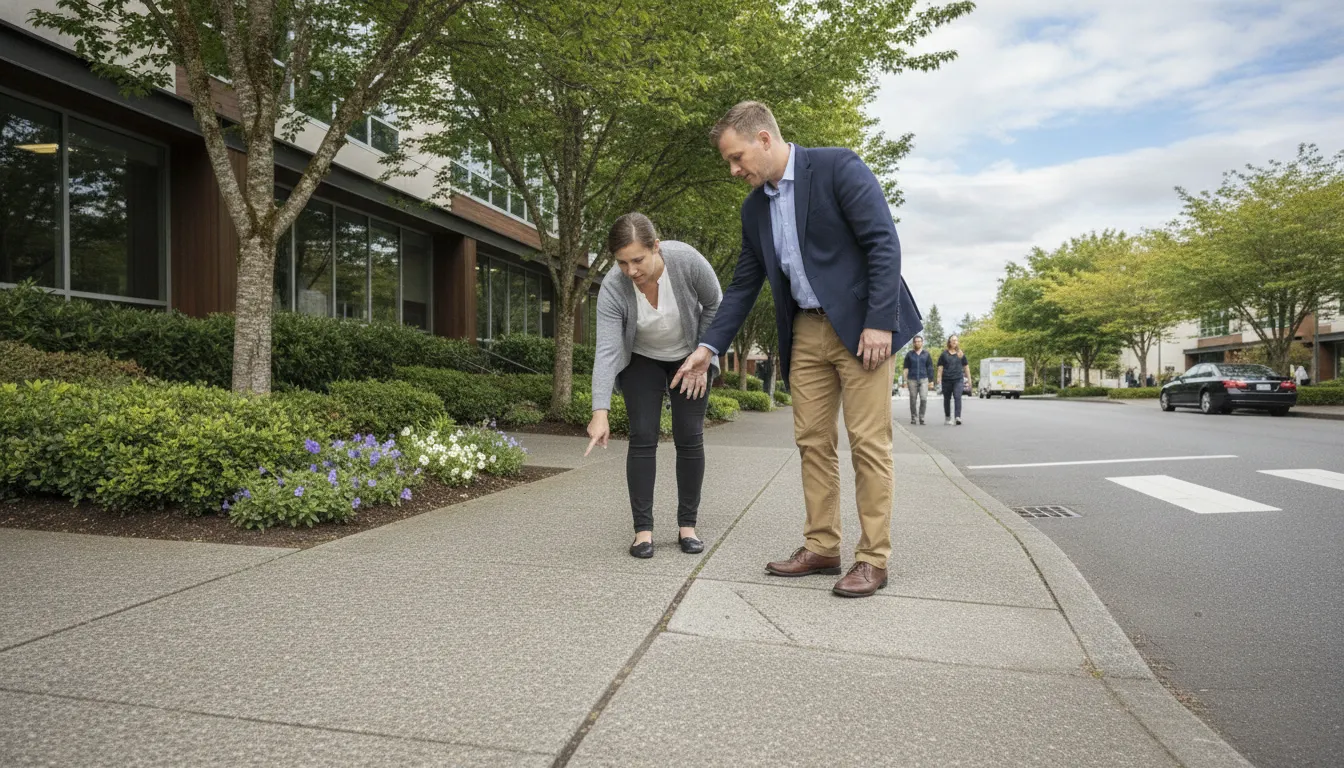
Begin by defining the area to inspect. That may be a commercial property, a campus, a managed portfolio, or a selected public route. Identify the boundaries before surveying so staff can tell which segments have been checked and which remain outstanding. If more than one person is inspecting, agree on the same naming conventions and fields before the work starts.
For each observation, record enough detail that another person can find and understand it later. Useful fields include:
- Location:
property or route name, street address or segment identifier, and a map pin or other repeatable reference.
- Condition:
a plain-language description of the change in surface, obstruction, or other concern.
- Evidence:
a dated photograph that shows the location and enough surrounding context to orient the reader.
- Accessibility context:
nearby crossings, entrances, curb ramps, transit stops, or other features that affect how people use the route.
- Action status:
observed, needs review, approved for work, scheduled, completed, or awaiting follow-up.
- Ownership and next step:
the person or team responsible for reviewing the item and the date for the next check.
Use neutral descriptions rather than conclusions that the inspection did not establish. For example, “vertical change observed at joint near the east entrance; review for accessibility and repair priority” is more useful than an unsupported statement that a location violates a particular rule. Record the observation and have the appropriate staff or qualified advisor evaluate what it means.
Photographs should support, not replace, location notes. Take a wider view to show where the condition sits, then a closer view if needed to explain what was observed. Keep filenames, dates, and location identifiers consistent. If the record is stored in a customer portal or geographic information system, confirm that staff can retrieve the original evidence and connect it to the work order.
How Should Portland Teams Set Repair Priorities?
Prioritization should make the reasoning visible. A simple review can consider the nature of the observed condition, how frequently the route is used, whether it connects important destinations, and whether an accessible alternative is available. The purpose is to identify which locations warrant prompt review and which can be incorporated into a planned work package—not to replace a formal accessibility evaluation or local direction.
Apply the same factors across the property or route. Otherwise, decisions may reflect who reported a condition most recently rather than a defensible view of need. When the available information is incomplete, mark the item for additional review instead of presenting an uncertain ranking as a final determination.
Planning situation | What to document | Practical next step |
Potential immediate access or safety concern | Exact location, date, photographs, route context, and who was notified | Use the organization’s established safety and escalation process, then arrange prompt evaluation |
Condition needs technical review | Observed change, nearby route features, evidence, and any missing information | Assign a reviewer and record the decision and follow-up date |
Several locations need attention | Consistent location IDs, priority rationale, access constraints, and work status | Group work where practical and coordinate scheduling by site or route |
Completed work needs to be tracked | Completion date, work record, updated photographs, and any remaining issue | Close or reopen the work order and retain the record for future planning |
This is a planning framework, not a Portland-mandated classification system. Your organization may have its own inspection, accessibility, procurement, or emergency procedures. Keep those requirements in the plan and confirm responsibilities with the relevant internal team.
What Portland Permit Questions Should You Confirm?
Do not assume that a sidewalk project is permit-free because its scope appears small. The City of Portland’s sidewalk repair guidance says that a property owner or contractor who wants to repair a sidewalk, curb, or driveway apron must have a Minor Improvement Permit. The City also provides an application page for voluntary sidewalk, curb, or driveway repair. Review the current City instructions and confirm which process applies to the proposed scope before work is scheduled.
Make permit review part of project intake, not a last-minute handoff. Identify who will confirm the permit path, who will submit any required documents, and who will coordinate questions with the City. Keep the decision and any application or approval records with the location’s work file. Requirements can depend on the work and its setting, so use the City’s current guidance rather than relying on an old project file or an assumption based on a nearby site.
For property managers coordinating work at a privately managed site, also clarify site access and any adjacent public right-of-way responsibilities. For public agencies, coordinate with the staff who oversee right-of-way permits, procurement, accessibility, and public communications. Those roles may sit with different teams; naming a single project contact helps prevent missed steps.
How Can You Coordinate Work With Less Disruption?
Residents, tenants, vendors, and visitors may rely on the same route throughout the day. A work plan should therefore state where the work will take place, the expected sequence, how people will be directed around the active area, and who will answer questions. Avoid promising a specific duration until the work scope and site conditions have been reviewed.
For a multi-building property or portfolio, consider organizing work in phases. A phase might cover a single building entrance, a group of nearby locations, or a route that can be managed together. The sequence should take account of access needs and operational constraints, not just the number of locations. Share the plan with on-site staff early enough for them to identify deliveries, events, or other scheduling conflicts.
Before mobilization, agree on a short scope record that states:
which locations are included, using the same identifiers as the inspection record;
the planned work method and the conditions that would prompt a scope review;
who confirms permits, access, notifications, and any required traffic or pedestrian management;
how the site team will receive schedule updates and report a new concern; and
what evidence and completion information will be returned for the maintenance record.
Precision Concrete Cutting describes its approach to accessible sidewalk repair and uses a precision cutting process for trip hazard removal. Work planning should still account for the actual site, approved scope, and applicable accessibility requirements. A project record should make clear what was addressed and whether any separate condition remains for follow-up.
How Can Sidewalk Records Support Long-Term Maintenance?
A one-time inspection is useful, but a maintained record helps teams see what has changed. Keep completed items in the inventory with their status and date rather than deleting them. That history can help distinguish a recurring concern from a newly observed one and can inform the next inspection cycle or budget discussion.
Choose a system the responsible team can keep current. A basic register should allow staff to sort by location, priority, status, and next action. Larger portfolios may benefit from mapping and data tools that connect field observations, work orders, and completion records. Precision Concrete Cutting’s sidewalk technology and data resources describe how location-based information can support project management; the right level of tooling depends on the scale and needs of the organization.
Set a review rhythm that fits your operations. After a project, confirm that completed locations are updated and unresolved items remain visible. During periodic planning, review the open list, note changes in use or site conditions, and identify records that need verification. A clear distinction between “not inspected,” “observed,” “under review,” and “completed” prevents an empty field from being mistaken for a cleared location.
It helps to define what a complete record looks like before a survey begins. For example, a record might remain open until it has a location ID, date, evidence, an assigned reviewer, and a decision or documented next step. Do not force every observation into a repair order: some may need a second look, coordination with another party, or a separate accessibility review. Preserve that status instead of closing an item simply because it has been discussed.
When the portfolio includes multiple properties, establish a common set of fields and then allow site-specific notes where needed. A common format makes it easier to compare work status across locations, while local notes retain the details that matter at a particular entrance or route. Decide who can edit records and how updates are approved. This avoids parallel lists with conflicting versions of the same issue and gives managers a reliable source for planning conversations.
Finally, keep the record useful to people who did not conduct the inspection. A short note explaining why an item was deferred or what information is outstanding can prevent repeated investigation. If a condition changes, add a dated update rather than silently replacing the earlier note. The history supports continuity, but it should not be treated as a substitute for checking current site conditions before work proceeds.
Good records also make handoffs easier. If staff, vendors, or property responsibilities change, another person should be able to understand the location, the decision history, and the next action without relying on informal memory. For more detail on how an assessment can support planning, see the sidewalk assessment information.
What Should You Prepare Before Requesting an Assessment?
A focused assessment request helps the reviewing team understand the site and its needs. Collect the property or route address, a point of contact, the approximate area to review, and any existing inspection notes. If there are several sites, prepare a list with a consistent identifier for each one. Include known access constraints or dates that may affect scheduling.
It is also useful to say what decision the assessment should support. You may need to understand the extent of observed trip hazards, organize a phased repair plan, document conditions for internal review, or evaluate options for a portfolio. State what records you already have and what remains uncertain. This keeps the conversation focused on the work to be evaluated rather than implying that an assessment automatically determines permit obligations or resolves every accessibility question.
Before the assessment, confirm who can authorize site access and who will receive findings. Afterward, compare the findings with the original inventory and capture any agreed next steps, including items outside the reviewed scope. A maintained record gives property managers and public works teams a practical basis for future coordination.
Frequently Asked Questions
Does every Portland sidewalk repair need a permit?
Do not assume that no permit is needed. Portland’s sidewalk repair guidance states that a property owner or contractor seeking to repair a sidewalk, curb, or driveway apron must have a Minor Improvement Permit. Check the City’s current instructions and confirm the requirements for the specific scope before scheduling work.
What information should a sidewalk inspection record include?
Record a consistent location reference, date, plain-language description, photographs, route context, status, and assigned next step. Use the same identifiers in inspection notes, work orders, and completion records so that staff can follow the item from initial observation through closeout.
How can a property manager prioritize several reported locations?
Use consistent factors such as the observed condition, route use, connection to important destinations, and available alternatives. Document why an item needs prompt review or can be planned with other work. Ask an appropriate reviewer to assess uncertain conditions rather than treating an informal ranking as a compliance decision.
Should repair work be scheduled one site at a time?
Not necessarily. Grouping nearby locations or phasing work by building or route may make coordination easier, provided access needs and site operations are considered. The best sequence depends on the locations, approved scope, and permit or scheduling requirements.
A consistent inspection and coordination process helps Portland property managers and public works teams turn sidewalk observations into traceable next steps. Confirm current City requirements for each project, keep the record connected to the work, and revisit unresolved locations during future planning.



Comments