How Often Should Sidewalks Be Inspected?
Updated: 1 day ago
A sidewalk can change between scheduled reviews. Tree roots rise, soil settles, storms shift slabs, and a previously level joint becomes a trip hazard. So, how often should sidewalks be inspected? The right answer is not one universal interval. It is a documented, risk-based schedule that combines frequent visual checks in priority areas with periodic professional condition assessments across the full network.
Request a professional sidewalk assessment to map hazards, prioritize risk, and turn field conditions into an actionable maintenance plan.
High-traffic and high-consequence walkways may warrant visual checks several times a year, while lower-risk areas can follow a longer locally approved cycle. A professional network-wide assessment should occur often enough to keep condition data useful for budgeting. Extra inspections should follow storms, freeze-thaw events, construction, complaints, or reported falls.
Municipalities, HOAs, and property managers should set their frequency according to local requirements, pedestrian volume, past defects, weather, asset age, and available resources. No single schedule replaces applicable laws, agency policies, or advice from legal and risk-management professionals.
How often should sidewalks be inspected?
A practical program uses two layers. Routine visual checks identify obvious new problems between formal assessments. Professional condition assessments create consistent measurements, GPS locations, photos, and priorities across the entire sidewalk inventory. The two layers work together: one catches rapid changes, while the other supports defensible planning and budgeting.
Use routine visual checks for changing conditions
Routine checks are focused observations completed by trained staff during normal operations or dedicated walkthroughs. Priority routes near schools, transit stops, senior communities, busy commercial areas, and public facilities generally deserve more attention than lightly used residential paths. Each organization should define its own intervals based on exposure and local policy rather than copying an arbitrary calendar.
A visual check should look for vertical displacement, broken or rocking panels, surface deterioration, obstructions, narrowed clear width, ponding water, and changes around curb ramps. The goal is not to complete a full engineering analysis. It is to identify conditions that require documentation, temporary controls, closer evaluation, or repair.
Use professional assessments for network-wide decisions
A professional condition assessment applies a consistent process across a larger sidewalk network. It can measure and classify hazards, connect each finding to a GPS location, and establish a repeatable baseline. The resulting inventory helps decision-makers compare locations and decide which work should happen first.
The Ohio Department of Transportation's active transportation guidance provides an example of a recurring inspection framework. But local owners should adopt a frequency that fits their responsibilities and conditions. Treat outside guidance as a planning reference, not a universal legal requirement.
Set intervals by risk, not convenience
Start by grouping sidewalks into risk tiers. A high-risk tier might include routes with heavy pedestrian use, vulnerable users, repeated complaints, or a history of displacement. A moderate tier may include shared amenities and common areas with regular use. A lower tier may cover lightly used routes with stable conditions and no recent issues.
Risk tier | Typical characteristics | Planning approach |
Higher | Heavy foot traffic, vulnerable users, recurring defects, or high-consequence locations | Frequent visual checks plus prompt follow-up after trigger events |
Moderate | Steady use, common areas, or some known condition changes | Regular visual checks and inclusion in each formal assessment cycle |
Lower | Light use, stable conditions, and limited defect history | Longer locally approved cycle with checks after reports or trigger events |
Record the rationale behind each tier and review it when land use, traffic, weather patterns, or claims history changes. A schedule is useful only when it reflects current risk.
Build a sidewalk inspection schedule around risk
A useful schedule tells staff what to inspect, when to inspect it, who owns the work, and what happens after a defect is found. It also separates recurring reviews from event-driven inspections. This structure makes the program easier to operate, audit, and improve as better condition data becomes available.
Map the network and define priority routes
Begin with an inventory of sidewalks, curb ramps, shared paths, and other pedestrian assets under your control. Divide the network into practical inspection zones. Then identify routes where a defect could have greater consequences, including areas around schools, transit, healthcare facilities, public buildings, commercial centers, and accessible entrances.
Past records are equally important. Locations with recurring root uplift, drainage problems, utility work, or repeated repairs may need a higher tier even if pedestrian traffic is modest. A risk-based schedule should respond to what the data shows, not just what a map looks like.
Assign ownership and a clear response process
Every inspection route needs an owner. Staff should know how to document findings, when to escalate a condition, and which team decides on temporary controls or permanent work. Define these steps in writing so responses remain consistent when personnel change.
The schedule should also distinguish between observation and evaluation. Staff can flag an issue, but qualified professionals may need to determine the appropriate remedy. A defined handoff prevents reports from sitting in an inbox without action.
Review the schedule using real results
After each cycle, compare the number, location, and severity of new findings with the prior period. If one route repeatedly produces urgent hazards, inspect it more often. If a stable area generates few changes across multiple cycles, your team may be able to redirect resources while remaining consistent with local requirements.
Inspection records also help teams identify patterns that a single field visit cannot reveal. Repeated movement near the same trees, drains, utility corridors, or slopes can justify a higher risk tier and earlier intervention. Over time, this history helps managers forecast needs, explain budget priorities, and direct limited resources toward the routes where timely work matters most.
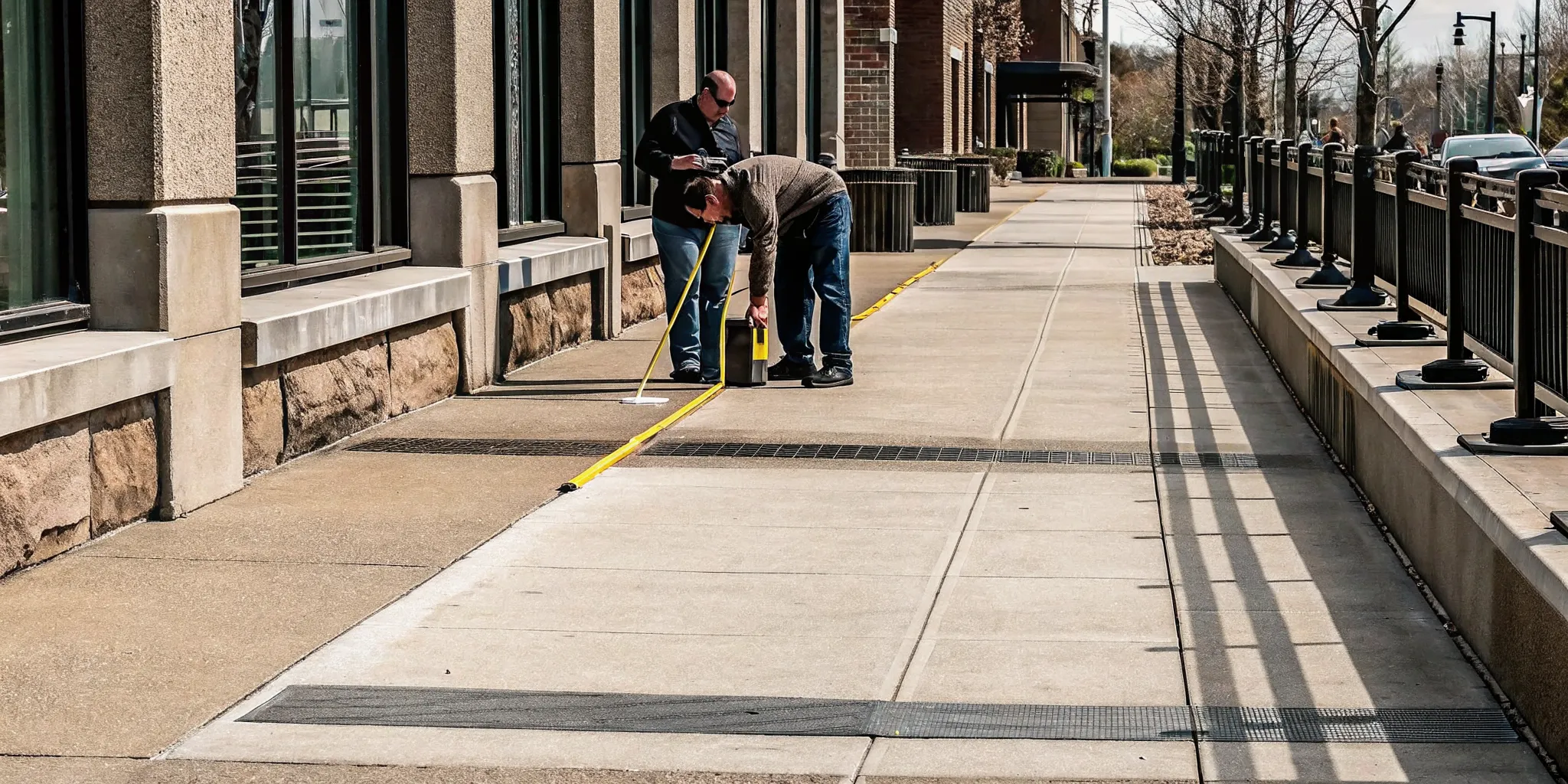
Consistent field documentation turns individual observations into a useful maintenance record.
What should trigger an extra sidewalk inspection?
Do not wait for the next scheduled cycle when conditions may have changed quickly. Severe weather, freeze-thaw activity, nearby construction, utility work, tree-root movement, complaints, reported falls, and high-attendance events can all justify a focused inspection. Define triggers in advance so staff know when and how to respond.
Weather and environmental changes
Heavy rain can erode supporting soil, while freeze-thaw cycles can move panels. Tree roots can also lift concrete over time. After a significant event, focus first on known problem areas, drainage paths, mature-tree corridors, slopes, and high-use routes. Compare new observations with earlier photos and measurements whenever possible.
Construction, utility work, and unusual loads
Work near a pedestrian route may disturb soil or place equipment loads on concrete that was not designed for them. Inspect affected paths after the work is complete and before removing temporary controls. Document responsibility, findings, and follow-up so the record is clear.
Complaints, incidents, and reported defects
A credible complaint or incident report should create a traceable response. Record when the report arrived, who inspected the location, what was observed, and what action followed. If the issue suggests similar conditions elsewhere, expand the inspection beyond the reported point.
Log the trigger, time, location, and reporting source.
Inspect the immediate area and nearby connected route.
Measure, photograph, classify, and map relevant conditions.
Apply appropriate temporary controls when needed.
Prioritize the permanent response and assign ownership.
Verify completion and update the condition record.
What should a sidewalk inspection document?
Useful inspection records are consistent, location-specific, and actionable. At minimum, document the asset location, observed condition, measurements, photos, date, inspector, risk classification, and recommended next step. Complete records help teams prioritize work, support budget requests, verify repairs, and maintain continuity across staff changes.
Condition and accessibility observations
Document vertical displacement, cracks, unstable or broken panels, surface deterioration, obstructions, ponding, cross-slope concerns, and conditions around curb ramps. Accessibility is broader than one measurement, so teams should evaluate the complete route and follow applicable standards. Precision Concrete Cutting's ADA compliance approach connects hazard removal with verification and reporting.
Location, severity, and supporting evidence
Each finding should be tied to a precise location. Photos should show context as well as the defect. Measurements and severity classifications should use the same method across inspectors. Consistency makes the inventory comparable and helps leaders understand why one location ranks above another.
Action, ownership, and verification
A finding without a next step is only a list item. Assign a response category, responsible party, target timing, and status. After work is complete, add verification photos and update the record. This closes the loop and creates a reliable history for future assessments.
Turn inspection data into a repair plan
Inspection data creates value when it guides action. A strong plan ranks hazards by exposure and severity, groups efficient repair routes, estimates budgets, and tracks completion. GPS-based records make it easier to move from scattered complaints to a repeatable sidewalk asset-management program.
Prioritize by consequence and condition
Do not prioritize only by defect size. Consider pedestrian volume, route purpose, accessibility, nearby facilities, previous reports, and the likelihood of conditions worsening. A smaller issue on a heavily used accessible route may deserve action before a larger condition in a lightly used location.
Match the response to the condition
Different conditions require different responses. When appropriate, PCC's patented cutting process removes trip hazards while preserving existing concrete. Conditions involving severe deterioration, drainage failures, or structural problems may require other work. A professional evaluation helps teams choose the right response instead of defaulting to full replacement.
Use reporting to support budgets
Mapped findings and documented priorities give leaders a clearer basis for funding requests. Teams can show the number and location of hazards, explain why certain routes rank higher, and report what was completed. Learn how PCC's sidewalk assessment, cutting, and reporting services support a data-driven maintenance program.
Frequently asked questions
Is there one required inspection frequency for every sidewalk?
No. Requirements vary by jurisdiction, owner, policy, and circumstance. A municipality, HOA, or property manager should confirm applicable obligations and create a documented schedule based on local rules and actual risk. Higher-risk routes usually warrant more attention than stable, lightly used areas.
What is the difference between a visual check and a professional assessment?
A visual check looks for obvious changes and urgent issues between formal cycles. A professional assessment uses a consistent process to measure, classify, photograph, and map conditions across a larger network. Both are important, but they serve different planning needs.
Should sidewalks be inspected after a storm?
A focused post-storm check is appropriate when heavy rain, flooding, freezing, fallen trees, erosion, or other conditions may have changed the walkway. Prioritize known trouble spots and high-use routes, then document findings and actions in the same system used for scheduled inspections.
How does GPS-based inspection data help?
GPS-based data ties each finding to a precise place and creates a reusable condition history. It helps teams compare risk, plan efficient repair routes, support budgets, verify completed work, and identify locations where hazards recur.
Build a safer, documented sidewalk program
A risk-based inspection schedule helps your organization find changing conditions, focus resources, and maintain a clear record of action. Precision Concrete Cutting can assess and map sidewalk hazards, prioritize repairs, remove eligible trip hazards with precision cutting, and report completed work.
Ready to replace guesswork with actionable sidewalk data? Request a professional assessment or call 1-877-224-0025 to discuss your network.


Comments