How Commercial Property Owner Sidewalk Liability Works: A Legal Guide
Updated: Sep 14
A raised sidewalk slab can become more than a maintenance item. For a commercial property owner, it may create an access problem, an injury risk, and a question about whether reasonable care was taken to keep the premises safe. The answer depends on local law, site conditions, and the owner's inspection and repair practices.
Schedule a sidewalk safety assessment to identify trip hazards, prioritize repairs, and document a practical path forward.
Commercial property owner sidewalk liability generally centers on maintaining safe sidewalks adjacent to the property, while local ordinances determine specific duties and exceptions. A practical risk-management program combines regular inspections, prompt trip hazard removal, accessible routes, and clear maintenance records.
That responsibility is not limited to reacting after someone falls. Understanding the legal duty for sidewalk safety helps property managers identify which hazards require attention, coordinate repairs across multiple sites. And build a defensible maintenance process before a claim or inspection brings the issue into focus. For a property-manager-focused framework, review Sidewalk Safety and Trip Hazard Solutions for Property Managers.
What Commercial Property Owner Sidewalk Liability Means for Your Property
Commercial property owners generally have a legal responsibility to maintain sidewalks adjacent to their properties. Although the exact duty depends on state law, local ordinances, and the property's use. In practical terms, owners and property managers should treat safe pedestrian access as an ongoing part of property operations. Not as a repair issue that matters only after someone is injured.
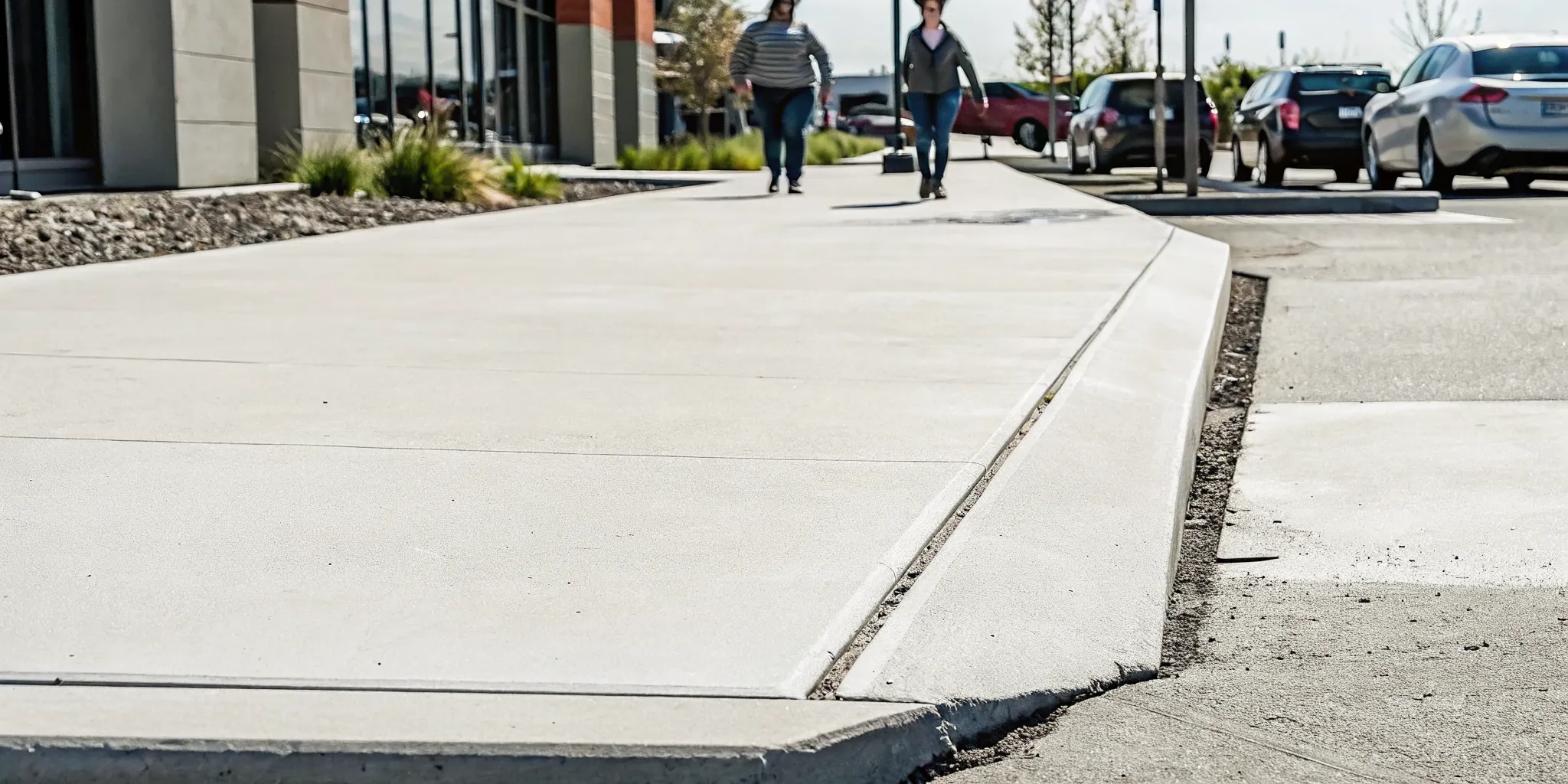
A raised concrete slab creates a trip hazard that can trigger liability claims. Regular inspections help catch these conditions early.
That duty commonly includes identifying and addressing conditions such as raised concrete, broken pavement, deteriorated surfaces, and blocked walking routes. It may also extend to environmental hazards. In some jurisdictions, owners can face liability for failing to clear snow or ice from an abutting sidewalk, even when the hazard is not a permanent defect. Tree roots can create another layer of complexity. When roots lift a slab, responsibility may involve the property owner, a tenant, the municipality, or whoever maintains the adjacent tree and parkway.
Commercial and residential responsibilities are not always the same
Commercial properties often receive greater scrutiny because they invite customers, tenants, employees, or members of the public onto the premises. A business owner or commercial property manager may therefore need to maintain accessible, reasonably safe paths from parking areas, public sidewalks, entrances, and other areas used by visitors. Lease agreements may assign maintenance tasks to tenants, but a private agreement does not necessarily eliminate every obligation imposed by local law or protect an owner from claims.
Residential responsibilities vary more widely. A single-family homeowner may be responsible for the sidewalk under a city ordinance, while another municipality may retain responsibility for repairs or impose only snow-clearing duties. Multifamily housing, condominiums, and homeowner associations can have additional obligations tied to common areas, governing documents, and resident access. Reviewing the applicable ordinance and documenting inspections is more reliable than assuming the city or a tenant will handle a hazard.
Vacant commercial property can still carry a duty
The New Jersey Supreme Court's 2024 decision in Padilla v. Young Il An illustrates how courts may interpret this responsibility broadly. The court held that owners of vacant commercial property could have a duty to maintain abutting sidewalks in reasonably good condition. The decision is jurisdiction-specific, but it reinforces an important management principle: a property does not stop creating sidewalk obligations simply because it is unoccupied.
Because rules differ by location, property teams should confirm who is responsible for each sidewalk segment, inspect hazards regularly, and keep records of notices, repairs, and follow-up checks. For a fuller explanation of how ownership, leases, municipalities, and site conditions can affect sidewalk maintenance responsibility, review the related guide.
Sidewalk Duties by Property Type
Property Type | Typical Duty | Common Exceptions |
Retail / Office (Owner-Occupied) | Full maintenance and repair of abutting sidewalks | Some cities retain responsibility for curb-to-curb repairs |
Retail / Office (Leased) | Lease-dependent; owner retains structural; tenant handles daily maintenance | Lease terms may shift snow/ice and minor repair duties to tenant |
Mixed-Use / Multifamily | Owner responsible for common-area walkways and public abutting paths | Tenant-accessed paths may fall under shared duties |
Vacant Commercial | Duty may still exist per case law (Padilla v. Young Il An) | Some jurisdictions limit duty to occupied properties only |
Industrial / Warehouse | Maintenance of loading and employee access routes required | Limited public access may reduce scope of duty |
What ADA Regulations Apply to Commercial Property Sidewalks?
Quick answer: Under ADA Title III, businesses and other public accommodations must provide accessible routes for people with disabilities. A sidewalk, walkway, entrance approach, or other path that serves customers and visitors can create an access problem when uneven surfaces or trip hazards prevent safe passage.
What counts as an ADA sidewalk violation?
A violation may occur when a commercial property fails to maintain an accessible path of travel serving a public area. The obligation is broader than the concrete directly in front of the main entrance. It can apply to connected walkways, routes between parking areas and buildings, and other pedestrian paths visitors reasonably use. ADA compliance is an ongoing obligation for all paths of travel serving public areas, not a one-time condition established when the property opens.
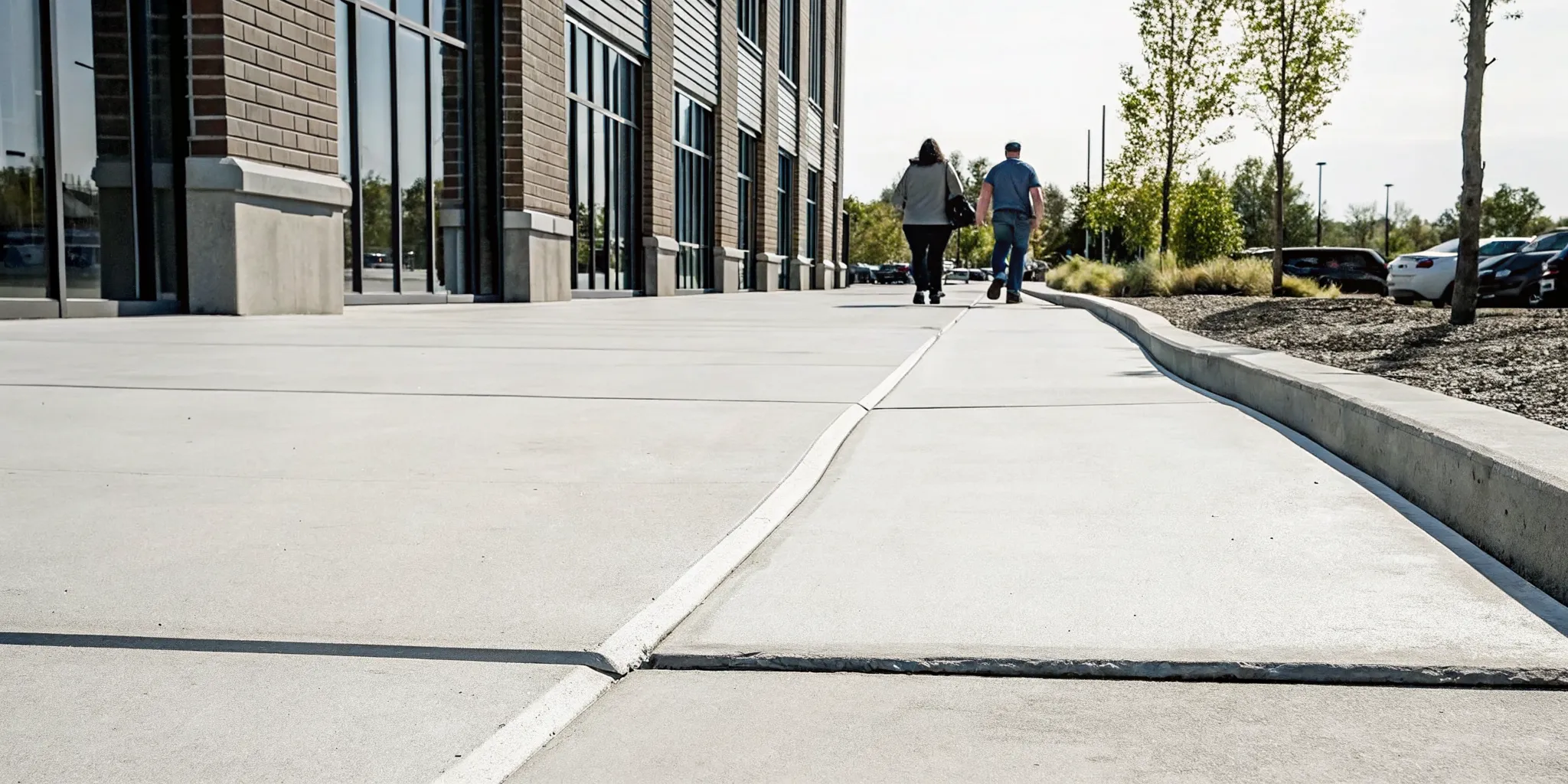
An accessible, well-maintained sidewalk helps commercial properties meet ADA requirements and reduce trip hazard exposure.
For a commercial property owner, the practical question is whether a person with a disability can use the route safely and independently. A raised joint, broken slab, or abrupt vertical change can make that route difficult or hazardous. Local building codes and municipal sidewalk rules may impose additional requirements, so owners should confirm site-specific obligations with qualified professionals.
How can owners address uneven sidewalk transitions?
Precision cutting removes the entire height of a concrete trip hazard and creates a smooth, ADA-compliant transition without the disruption of full concrete replacement. This approach can help property managers address priority hazards quickly while keeping more of the existing walkway in service. It is one practical option to evaluate alongside replacement, especially when a portfolio includes multiple sites and repairs must be phased.
Q: Does ADA compliance apply only to the front entrance?
A: No. The requirement can extend to every accessible path of travel that serves public areas. Property managers should inspect the complete route from parking and public sidewalks through entrances and other visitor destinations, rather than checking only the doorway.
Q: Where can commercial owners review the requirements?
A: Review these ADA sidewalk compliance requirements, then pair that information with a site-specific inspection and a documented repair plan. A practical compliance process should identify hazards, assign responsibility, complete repairs, and retain records for future maintenance decisions.
How Slip-and-Fall Claims Are Won and Lost: What Documentation Matters
Trip hazards on neglected sidewalks are a major source of premises liability claims for property owners. For a commercial property owner, sidewalk liability often turns on whether the owner had a duty to maintain the area. Failed to address a known or reasonably discoverable hazard, and contributed to an injury. Local ordinances and the facts of the incident still control the legal analysis.
What must an injured person prove?
Although requirements vary by jurisdiction, a claimant generally needs evidence of four elements:
- Duty:
The owner, manager, tenant, or another responsible party owed a duty to maintain reasonably safe premises.
- Breach:
A dangerous condition existed, and the responsible party failed to repair it, warn people, or take reasonable steps to prevent harm.
- Causation:
The condition, such as a raised slab or slick walking surface, substantially contributed to the fall.
- Damages:
The claimant experienced documented losses, such as medical expenses, lost income, or other legally recognized harm.
Weather can raise the stakes. Slick sidewalks are a predictable injury risk, and fall-related hospital visits can spike during winter. Depending on local law, responsibility may include responding to ice or snow as well as repairing concrete defects. A commercial general liability policy may cover premises-related accidents, but exclusions, limits, notice requirements, and other conditions apply. Insurance is not a substitute for preventive maintenance.
What records should property owners keep?
Strong records show what the owner knew, what the owner did, and when the work occurred. Keep dated inspection reports, photographs showing the condition and surrounding area, work orders, repair invoices. Snow and ice response logs, contractor communications, incident reports, and records of warnings or temporary barriers. A consistent inspection schedule is more persuasive than a record created only after someone is injured.
Maintenance records can serve as evidence that the owner took its duty of care seriously. They also help property managers prioritize hazards across multiple sites, communicate repair status, and demonstrate that urgent issues were not ignored. Keep records factual and preserve the original photographs and timestamps.
Q: Does insurance eliminate sidewalk liability?
A: No. Coverage may help address a covered claim, but it does not establish that the property was reasonably maintained. Review policy terms with a qualified insurance professional and maintain an independent inspection and repair process.
Q: What should happen after a reported hazard?
A: Document the report, inspect the location promptly, protect pedestrians from immediate risk, arrange an appropriate repair, and record completion. A repeatable process creates a clearer record than informal texts or undocumented verbal promises.
What Happens When a Commercial Property Fails an ADA Inspection?
When an ADA inspection identifies inaccessible routes or sidewalk trip hazards, the property owner should treat the result as a corrective-action priority, not a one-time report. The consequences can include enforcement activity, private litigation, added legal costs, and greater exposure to injury claims, depending on the facts and jurisdiction.
Potential enforcement and legal costs
The Americans with Disabilities Act requires accessible paths serving commercial properties. A failed inspection may lead to a demand for corrective action or involvement from the U.S. Department of Justice. DOJ enforcement can carry civil penalties, remediation requirements, and the cost of bringing the property into compliance. Penalties and procedures vary, so owners should consult qualified counsel about the rules that apply to their property.
Private parties may also bring lawsuits when an inaccessible route limits access or when a sidewalk defect contributes to an injury. In addition to defense costs and possible damages, a case may involve attorney fees, expert review, accessibility evaluations, and disruption for tenants and visitors. Insurance may respond to some premises-related accidents, but coverage conditions and exclusions differ by policy. Insurance should not replace a documented prevention program.
Build a corrective action plan
A failed inspection should produce a written plan that identifies each deficiency, assigns responsibility, set repair priorities, and records completion. Start with hazards that affect high-traffic routes, entrances, curb connections, and other areas necessary for safe access. Pair photographs and measurements with work orders, invoices, inspection dates, and post-repair verification. This record shows that the owner acted promptly rather than ignoring a known condition.
Regular inspections and prompt trip hazard repair are critical to liability mitigation. A proactive sidewalk safety program also helps demonstrate that the owner is meeting a continuing duty of care. For a practical starting point, use this sidewalk safety audit to organize recurring reviews across a property or portfolio.
Manage repairs without delaying critical risks
Not every deficiency must be addressed through a single, disruptive project. Phased repair planning can control costs while critical risks are corrected first. A property manager might prioritize accessible routes and severe elevation changes, then schedule lower-risk areas in later phases. The plan should include interim controls, clear deadlines, and follow-up inspections so phased work does not become deferred work.
Request a property sidewalk assessment when your team needs a clear inventory of high-priority walkway hazards and a repair plan that fits active operations.
How Precision Concrete Cutting Creates a Defensible Repair Record
A defensible sidewalk maintenance record connects three things: the hazard identified, the corrective work performed, and the condition left behind. For a commercial property owner, that documentation can help demonstrate a consistent effort to provide safe, accessible paths and respond to known risks. Precision Concrete Cutting supports that process as a technology-enabled partner, not simply as a crew dispatched to make a one-time repair.
Documenting the condition and the corrective action
Precision cutting removes the full height of a concrete trip hazard and creates a smooth, ADA-compliant transition. The result is a clear before-and-after point in the maintenance record: a specific defect was identified, sliced, and corrected without replacing an entire section of sidewalk. Records of inspections, repair locations, work performed, and completion dates give property teams an organized evidence trail when reviewing past maintenance or responding to a claim. Documentation does not eliminate liability, and local requirements vary, but clear maintenance records can help show that the owner took reasonable steps to address a known condition.
The repair method also supports practical site operations. Sidewalk slicing is faster and quieter than more disruptive replacement work. And it does not introduce the patch edges or uneven replacement slabs that can create additional trip concerns. That makes it easier for property managers to schedule work with less disruption to tenants, visitors, and daily access while preserving a precise record of what was addressed.
Turning repair records into portfolio intelligence
For owners and managers with multiple properties, a spreadsheet or folder of work orders may not provide enough visibility. PCC's GIS technology enables teams to map, track, and manage sidewalk hazards across an entire property portfolio. A mapped record can connect each location to its inspection status, repair history, and remaining priorities, helping managers coordinate recurring reviews and identify patterns across sites.
This portfolio view changes sidewalk maintenance from a reactive response into a documented asset-management program. Teams can prioritize high-risk locations, plan work in phases, and retain a consistent history for property owners, boards, operations leaders, and compliance reviews. It also gives stakeholders a practical way to see how repair decisions support accessible paths and ongoing risk management.
For a broader framework for reducing exposure and organizing site-level action, see Sidewalk Safety and Trip Hazard Solutions for Property Managers. A structured program that combines precision cutting, GIS mapping, and maintenance documentation gives commercial property teams a more defensible approach to sidewalk safety.
Talk with Precision Concrete Cutting about your sidewalk safety program to prioritize trip hazard removal and create clear repair records across one property or a full portfolio.
Frequently Asked Questions
Is a commercial property owner liable for sidewalk injuries?
Generally, commercial property owners are responsible for maintaining safe sidewalks next to their property. But the exact duty depends on local ordinances and the condition that caused the injury. Regular inspections and prompt correction of trip hazards help demonstrate that the owner took reasonable steps to provide safe access.
Who is responsible for sidewalk repairs in front of commercial property?
Responsibility is often assigned to the property owner, although municipal rules may place some duties on a tenant, city, or other party. Review the applicable local ordinance before scheduling work, especially when damage involves tree roots, snow, ice, curbs, or the parkway area.
Does commercial property insurance cover sidewalk accidents?
Many commercial general liability policies include coverage for premises-related accidents, but exclusions, limits, deductibles, and policy conditions vary. Insurance does not replace maintenance: confirm requirements with your insurance professional and keep inspection, repair, and incident records.
How can property managers reduce sidewalk liability?
Use a repeatable program that inspects high-traffic areas, records hazards, prioritizes urgent repairs, and documents completed work. A portfolio-wide map or GIS record can help coordinate multi-site maintenance, while phased repairs address the most critical risks within budget.
What is the commercial property owner's role in ADA sidewalk compliance?
Owners must help ensure accessible paths serving public areas remain usable for people with disabilities. Compliance applies beyond a single entrance, so review the full route and repair changes in level that create barriers. Precision cutting can remove the height of a concrete trip hazard and create a smooth transition.



Comments