
Fast, Affordable Sidewalk Repair Across Arizona
Eliminate Trip Hazards Quickly — No Demolition, No Downtime, No Disruption
Precision Concrete Cutting provides professional, non-invasive sidewalk repair services throughout Arizona. Using specialized cutting technology, we remove trip hazards, level uneven slabs, and restore smooth walkways — all without jackhammers, demolition, or major construction. Whether you manage a residential property, commercial site, or public walkway, we deliver ADA-compliant results with unmatched efficiency and minimal disturbance.
Why Sidewalk Repair Is Crucial in Arizona
Arizona’s extreme temperatures, dry climate, and shifting desert soils can quickly cause sidewalks to crack, settle, or heave. Over time, these environmental factors lead to unsafe walking surfaces, which can create significant liability for property owners.
In many Arizona cities, the adjacent property owner is legally responsible for sidewalk maintenance. Ignoring raised slabs or cracked sections can result in trip-and-fall incidents, city citations, and costly repairs. That’s why early action — using a non-invasive solution — is the smart, safe, and cost-effective choice.


Trip Hazards Are a Legal & Safety Risk
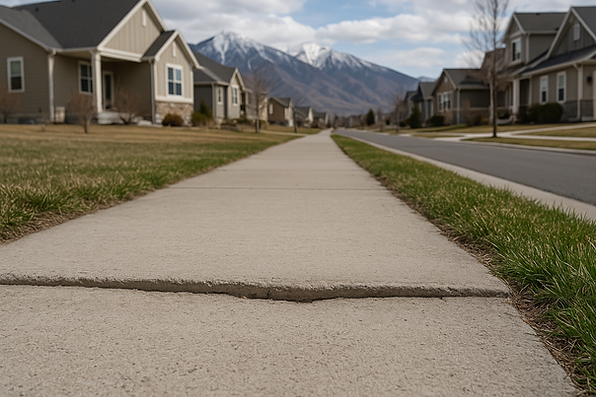
Even a small sidewalk offset can lead to serious injuries. Raised panels, sunken edges, or root-lifted slabs are common causes of pedestrian falls — and property owners may be held liable if they fail to address the issue.
The traditional fix? Concrete demolition and full replacement — which can take days, block walkways, and cost thousands. Precision Concrete Cutting offers a non-invasive alternative that removes hazards without disrupting foot traffic or damaging the surrounding area.
Tucson Sidewalk Safety & ADA Compliance Standards
Tucson enforces sidewalk maintenance under the Tucson Code Chapter 20 (Streets, Sidewalks, and Public Ways) and Pima County ordinances that place trip hazard liability on property owners and responsible municipal entities.
The Sonoran Desert climate—with extreme UV exposure, monsoon-driven soil expansion, and 100°F+ summer temperatures—accelerates concrete deterioration across high-traffic areas including the University of Arizona campus, Downtown Tucson, Fourth Avenue, the Tucson Convention Center, and master-planned communities in Oro Valley, Marana, and Sahuarita.
ADA Title II and Title III classify any vertical displacement of ¼ inch or more as a trip hazard requiring remediation. Precision Concrete Cutting's patented technology achieves a 1:12 slope, the same slope standard the ADA sets for ramps, and eliminates 100% of trip hazards in a single treatment. From our Mesa regional office, we serve municipalities, HOAs, school districts (including TUSD), hospitals, commercial centers, and apartment complexes across the greater Tucson metro and Pima County.


Why Arizona Trusts Precision Concrete Cutting
We focus exclusively on sidewalk safety — and we do it better, faster, and cleaner than traditional contractors. Arizona clients trust us because we help reduce liability, extend the life of their concrete, comply with ADA and local codes, and complete the work without disruption or downtime.
There’s no excavation, no loud equipment, and no need to tear up the concrete — just smooth, safe sidewalks restored in a fraction of the time.

PRECISION CONCRETE CUTTING
Sidewalk Asset Management
Precision Concrete Cutting provides comprehensive Sidewalk Asset Management solutions designed to support full-service sidewalk management plans and ADA transition plans.
Using an advanced ArcGIS system / GIS Mapping System, we document every sidewalk condition with precise GPS coordinates, severity ratings, and time-stamped before-and-after photos. This data integrates directly into your existing GIS platform, making planning, budgeting, and compliance reporting simple and defensible.
You’ll also have access to a live mapping portal to track repairs, monitor progress, and maintain full transparency.
With PCC, you’re not just fixing trip hazards — you’re implementing a smarter, data-driven sidewalk management strategy.

Specialized Tools. Clean Process. Safer Sidewalks.
Our patented cutting technology removes trip hazards with precision and control. Every job is documented and verified to ensure full compliance, giving you confidence in your sidewalks — and protection from liability.
This is sidewalk repair tailored for Arizona’s unique climate and infrastructure — non-invasive, efficient, and effective.
How It Works
.png)
Step 1: Schedule Your Assessment
We start by inspecting your sidewalk to identify every trip hazard—no matter how small or where it's hiding. Our team pinpoints raised slabs, cracks, and misaligned panels, ensuring we understand the full scope of the issue before we begin.
.png)
Step 2: Patented Cutting Technology
Unlike grinders or patch jobs, our cutting system is built to do the job right the first time. It reaches the edges, works at any angle, and eliminates the entire height difference between slabs. This ensures a smooth, safe transition that meets ADA compliance—without damaging surrounding areas.
.png)
Step 3: Hazards Removed. Safety Restored.
In just minutes per hazard, our team removes the raised concrete to create a level, clean walking surface. No demolition. No messy debris. No long delays. Your sidewalk is safe to walk on immediately after the job is done.
Ready to Repair Your Sidewalk in Arizona?
Don’t let a trip hazard turn into a lawsuit or citation. Precision Concrete Cutting provides fast, non-invasive sidewalk repair across Arizona — with no demolition, no construction zones, and no stress.
Contact us today for a free inspection and no-obligation quote. Let us help you make your walkways safer, smoother, and fully compliant — the smarter, cleaner way.
Serving in and Around Arizona Community
We also serve Avondale, Buckeye, Casa Adobes, Casa Grande, Flagstaff, Goodyear, Maricopa, Queen Creek, San Tan Valley and Yuma in Arizona.
Our Arizona office: 1110 South Horne, Mesa, AZ 85204. Call 1-877-224-0025.